Ferrari's Special Series Cars: Why Challenge Stradale, Scuderia and Pista Values Diverge From the Base Models
T
he mid-engine V8 has been Ferrari's core road car for four decades, and for roughly the last twenty years the company has sold each generation of it twice. First as the standard berlinetta, then — two or three years into the cycle — as a lighter, harder, race-derived variant offered to a narrower list of clients.Four of those cycles are now complete. The 360 Challenge Stradale, the 430 Scuderia, the 458 Speciale and the 488 Pista each settled well above the standard car they were derived from, and the distance between the two has widened with every generation.
A note on method before any numbers. Ferrari publishes power and dry-weight figures, but it has never published coupe production caps for most of these cars, and it does not publish transaction data.
Every value figure here is an estimate assembled from public auction results and price-guide data. Verify against the Hagerty Price Guide and recent Bring a Trailer, RM Sotheby's, Gooding & Company and Broad Arrow lot records before you transact.
The Four Cycles, In Order
The pattern is consistent enough to read as a product strategy rather than a series of one-off projects. Ferrari's stated specifications for each car include but are not limited to:
- 360 Challenge Stradale (2003–2004). Ferrari quoted 425 cv and a dry weight roughly 110 kg under the 360 Modena, reached through Lexan rear glass, thinner panels, a stripped cabin and carbon-ceramic brakes. Production estimates cluster around 1,288 cars worldwide; treat that as an estimate and confirm through build documentation or Ferrari Classiche.
- 430 Scuderia (2007–2009). 510 cv from the 4.3-liter V8, approximately 100 kg below the F430 on Ferrari's stated dry weight, with the F1-SuperFast2 gearbox and the integration of E-Diff with F1-Trac. The open version, the Scuderia Spider 16M, was capped at 499 cars.
- 458 Speciale (2013–2015). 605 cv (597 hp) from a 4.5-liter naturally aspirated V8 turning to 9,000 rpm, roughly 90 kg lighter than the 458 Italia, and the introduction of Side Slip Control. The 458 Speciale A was capped at 499 cars.
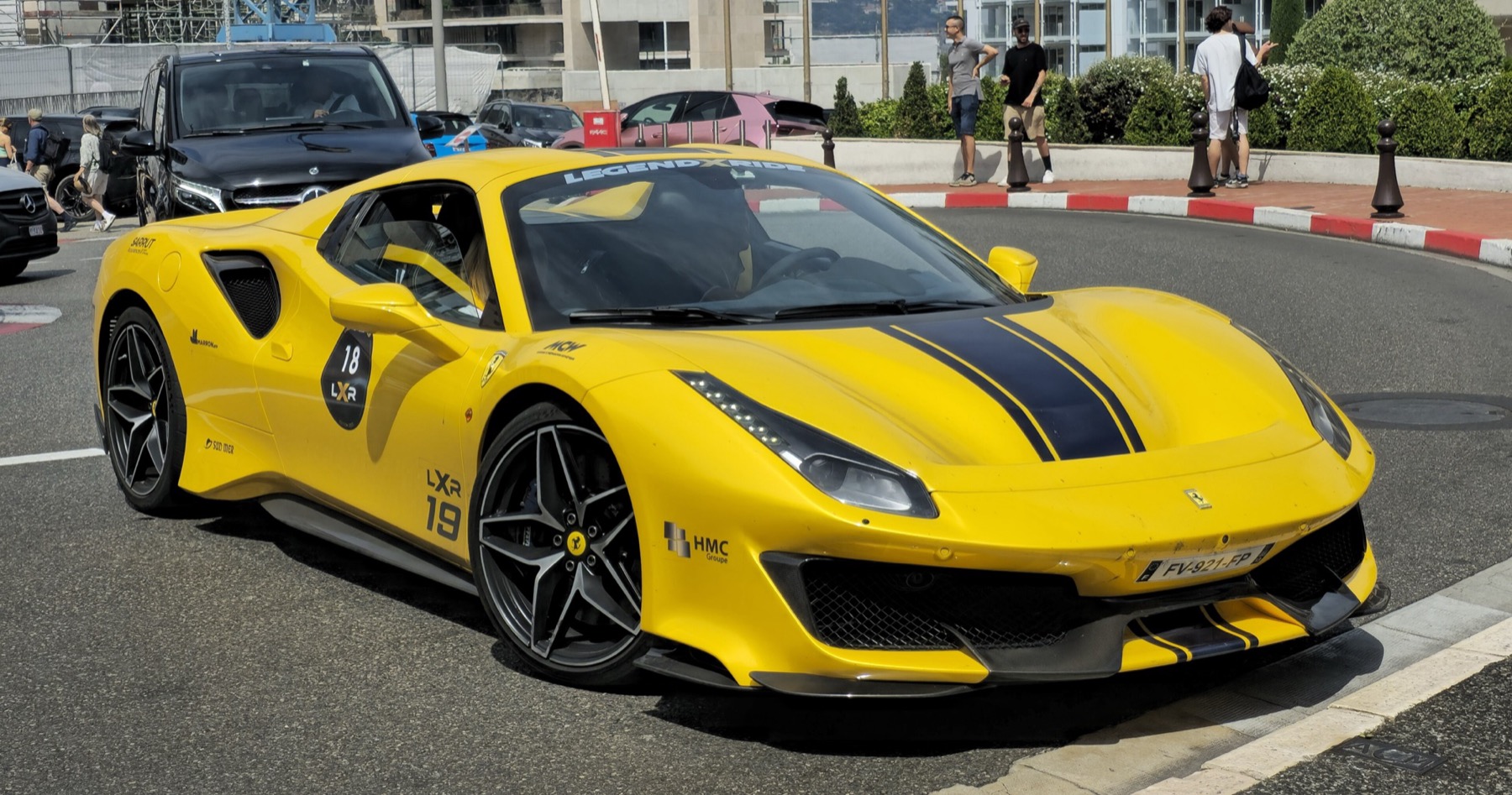
- 488 Pista (2018–2020). 720 cv (710 hp) from the 3.9-liter twin-turbo V8, again about 90 kg lighter, with cooling and aerodynamics — including the S-Duct — derived from the 488 Challenge and 488 GTE. Carbon-fiber wheels were a factory option and now behave as a specification variable in resale.
All four share the same commercial shape: a fixed, comparatively small build set against a base model that Ferrari continued to produce in volume for years afterward.
What Ferrari Actually Changes
The weight figure is the headline, but it is the least interesting part of the engineering. Each special series takes the base car's engine to a higher state of tune, revises gearbox software for shorter shift times, replaces the sound package, and adds aerodynamic and cooling hardware validated on the Challenge or GT race program.
The chassis calibration matters more than any of it. Ferrari uses these cars to launch a control system — E-Diff and F1-Trac integration on the Scuderia, Side Slip Control on the Speciale — which then migrates into the following generation's standard model.
That sequencing is why the special series reads as a technical marker rather than a trim level. It is the car in which a generation's engineering thesis is stated most plainly, and buyers price it accordingly.
Why The Gap Widens With Each Cycle
Base-model supply is the first driver. Ferrari's annual shipments roughly doubled between the mid-2000s and the end of the last decade — the company reported 10,131 units shipped in 2019 — while special-series allocation stayed narrow and invitation-based.
The arithmetic follows from that. A 488 GTB competes against a far larger installed base of same-generation cars than a 360 Modena ever did, so the ratio between special-series scarcity and base-model availability keeps moving in the special car's favor.
Buyer behavior compounds it. These cars are frequently bought as terminal holdings — stored, lightly used, retained through cycles — while base cars are bought to be driven, which steadily separates the two condition pools.
The Naturally Aspirated Cutoff
The 458 Speciale occupies a position that cannot be granted to another car retroactively. It is the last naturally aspirated mid-engine V8 Ferrari special series, because the 488 that replaced the 458 moved the entire line to twin turbochargers.
Markets pay for category endings. The same logic underwrites air-cooled 911 values and the pricing of the Lexus LFA, and it is the single hardest variable for a later car to reproduce.
There is a second scarcity that often goes unnoticed. The F8 Tributo generation never received a special series at all, so five generations of mid-engine V8 have produced only four of these cars — a thinner supply line than the model calendar suggests.
Where The Base Car Fights Back
One correction changes buying decisions here: neither the Challenge Stradale nor the 430 Scuderia was offered with a gated manual. Both were built exclusively with Ferrari's paddle-shifted automated manual, which places the era's manual scarcity with the base 360 Modena and F430 instead.
That has produced real convergence. Well-documented manual F430s have moved toward Scuderia money in recent public sales, so the assumption that the special series always leads fails inside that one generation — verify current spreads before you rely on a direction.
The broader point is that gearbox, specification and documentation can outweigh the badge. Our survey of manual-gearbox supercars covers where that premium is strongest, and the used 488 market shows how quickly a generation's ordinary cars find their floor.
How To Read The Transaction Data
Condition tier does more work here than mileage alone. A driver-grade Speciale with 12,000 miles, complete books and tools and an unbroken Ferrari-authorized service record will regularly outperform a 3,000-mile car with a thin file and unexplained paint.
Service history is the cheapest insurance available to you. The 360 uses a timing-belt engine with an engine-out service interval while later cars moved to chains, so a Challenge Stradale without documented belt work carries an obligation that should come out of the price.
Track use is the variable most often concealed. Ask for brake and tire replacement records, look for telemetry logs, harness mounting or roll-bar hardware, and treat a car offered immediately after a season of track days as a car with unpriced maintenance ahead of it.
What This Implies For The Current Halo Cars
The hybrid generation breaks at least one assumption in the model. The 296 line pairs a twin-turbo V6 with an electric motor, and Ferrari has since introduced a Speciale version of it — verify its published output, weight and any production cap against Ferrari's own specifications before you build a value case on it.
The open question is the battery. Twenty-year residual behavior for a high-voltage traction pack has no precedent in this category, and replacement cost and parts availability at that horizon are not yet established.
Allocation is the other constraint. A place on the list depends on purchase history and dealer relationship rather than deposit timing, a dynamic covered in our piece on Ferrari allocation reality and visible across the market for the 296 and its rivals.
Cross-shopping helps calibrate all of this. The McLaren 750S and the Ferrari 12Cilindri sit on either side of the conversation, and both illustrate how differently the market treats series-production performance and a capped, invitation-only build.
Editorial Recommendation
What follows is our current reading, written as a specification list rather than a ranking:
- For the cleanest version of the pattern. A 458 Speciale coupe, moderate mileage, complete books and tools, no evidence of undocumented track work and continuous Ferrari-authorized service. It carries the naturally aspirated cutoff and the strongest documentation culture of the four.
- For usability. A 488 Pista with a verified service file and, if fitted, carbon wheels in confirmed condition. The turbocharged drivetrain is the most tolerant of regular use, and eligibility for Ferrari's extended maintenance and warranty programs should be confirmed with an authorized dealer.
- For the entry point. The two earliest cars, the Challenge Stradale and the Scuderia, trade closest together — buy the file rather than the badge, and price the belt service on any 360-based car before you agree a number.
- If a manual is the requirement. Look at a base 360 Modena or F430 with the gated six-speed rather than a special series, since neither the Challenge Stradale nor the Scuderia was built that way.
- Before any purchase. Commission a pre-purchase inspection at a marque specialist, and confirm every value assumption against current Hagerty, Bring a Trailer and major-auction results rather than asking-price listings.
All of these cars reward the same discipline, in the same order: documentation, then specification, then patience.
Where To Take This Next
Buying any of them is a geography problem as much as a market one, because inventory, inspection capability and dealer relationships concentrate in a handful of metros. Our guide to buying a Ferrari in Miami covers how that plays out in one of the deepest US markets for these cars.
If you are weighing a special series against a well-optioned standard car, the practical question is how you intend to use it. Start with the model coverage linked above, then verify every figure against a current price guide before you commit to a number.