Ferrari.
Italian thoroughbreds with the most stringent allocation policy in volume luxury.
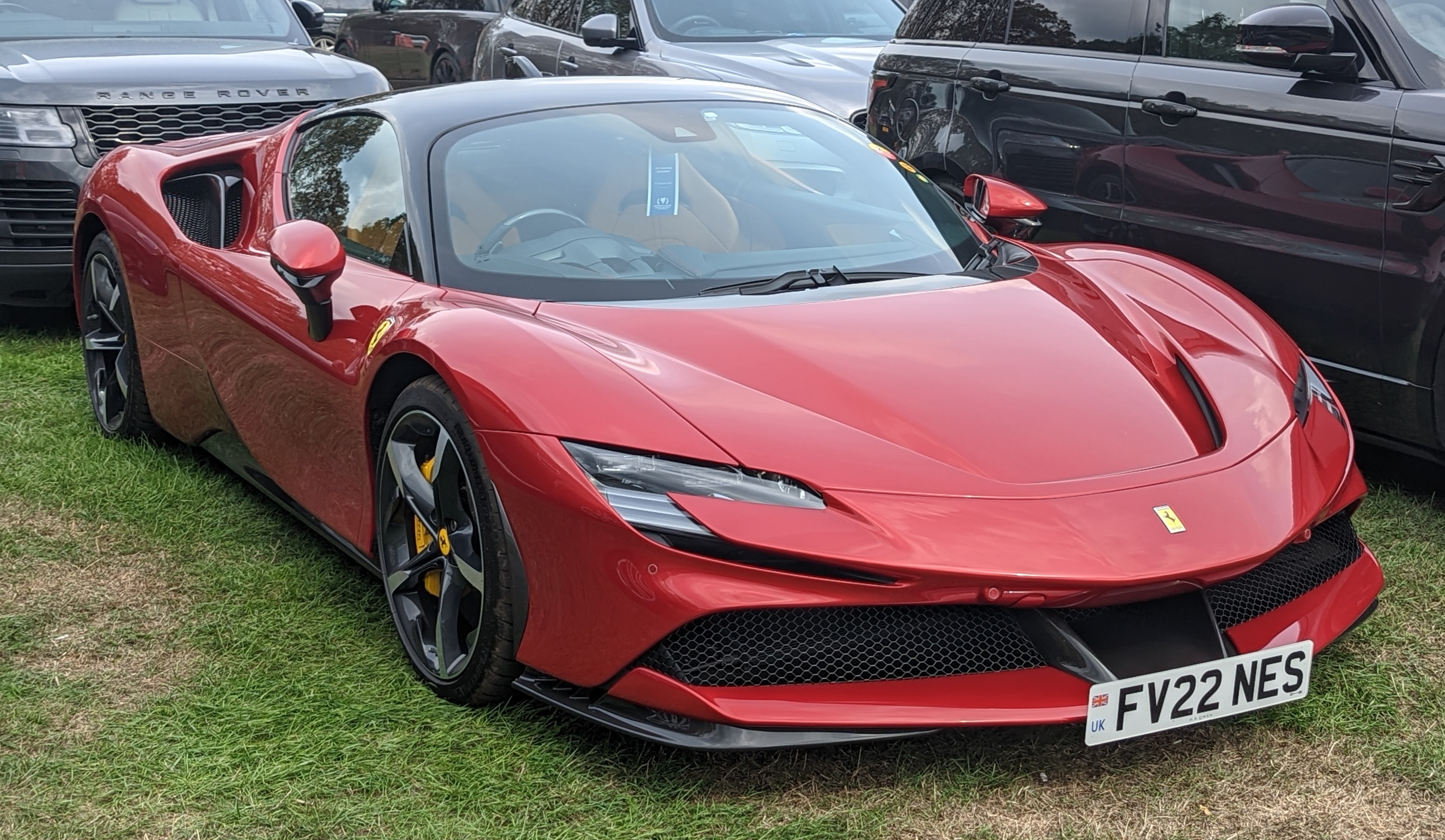
- Founded1939
- HeadquartersMaranello, Italy
- CountryItaly
- TierHypercar
What is Ferrari today?
Ferrari is an Italian luxury sports-car and hypercar marque founded in 1939 by Enzo Ferrari and headquartered in Maranello, Emilia-Romagna. The company has been publicly traded on the NYSE since 2015. The current lineup runs from the 296 through the SF90 and 12Cilindri to the Purosangue — Ferrari's first four-door, four-seat car.
Who owns Ferrari?
Ferrari is publicly traded on the New York Stock Exchange under ticker RACE since the 2015 IPO and on the Milan exchange as RACE since 2016. Exor N.V., the Agnelli family holding company, is the largest single shareholder with roughly 24% of voting rights. No automotive group owns Ferrari.
How does Ferrari allocation work?
Ferrari operates the most stringent allocation policy in volume luxury. Most cars are not order-able by walk-in buyers; allocation runs through dealer-managed customer relationships, prior Ferrari ownership history, and an unwritten loyalty calculus. Limited-edition cars (Icona series, Special Series) require multiple prior Ferrari purchases as informal prerequisites for consideration.
What does Ferrari ownership cost?
Scheduled service falls to the owner only after the seven-year Genuine Maintenance period; before that it is included. Tires are a meaningful line item; the ownership calculator prices a set for the specific trim. Insurance varies dramatically by model and policy structure. First-year depreciation on volume models runs 15-22%. Limited-edition Ferraris (Icona, Special Series, single-supercar) historically appreciate; standard-spec V8 berlinettas depreciate moderately by segment standards.
Where do you buy a Ferrari?
Ferrari sells through authorized US dealers only. Walk-in showroom orders are largely impossible for current allocation; entry to the marque typically begins with a 296 order, followed by V8 berlinetta consideration, and only then limited-series allocation. Dealer relationships are operationally the most important variable in Ferrari ownership. Marque lists five Ferrari dealers across its ten covered metros; Ferrari's own dealer locator is the current list for the rest of the country.
History
Enzo Ferrari founded Auto Avio Costruzioni in 1939, after leaving the Alfa Romeo racing team he had run for two decades. A non-compete clause from his Alfa contract prevented him from using the Ferrari name on a car for four years; the first car badged "Ferrari" was the 125 S in 1947, and the road-car business has run continuously from that point. The road cars existed, in Enzo's framing, primarily to fund the racing program.
Through the 1950s and 1960s Ferrari became synonymous with both Formula 1 and the GT-and-sports-car segment of the road-car market. Fiat acquired a 50% stake in 1969 (later expanded to 90%); the Fiat ownership funded a long capital-investment program at Maranello while leaving the engineering culture intact. Ferrari was carved out of the Fiat Chrysler group in 2015 and listed independently on the NYSE; the company has operated as a stand-alone luxury manufacturer since.
The modern Ferrari is the most allocation-disciplined volume manufacturer in the segment — production levels are deliberately constrained, the dealer network is small relative to the brand's reach, and the Special Series and limited-production cars (LaFerrari, Monza SP1/SP2, Daytona SP3, Icona series) run on existing-customer-priority allocation that the standard buyer does not access. The Purosangue (2022, four-door, V12) marked the marque's most consequential lineup expansion in decades.
Anchored on the Ferrari Roma — built through 2024, replaced by the Amalfi.
Source: Industry composite estimate, 2024. Limited-edition Ferraris track materially differently — see model pages.
Positioning
Ferrari sits at the racing-pedigree end of the supercar and hypercar segment. The marque's product strategy is built around three streams: the standard lineup (296, SF90, 12Cilindri, Purosangue, with the Roma in its last production years), the Special Series cars (limited-volume, technical-demonstration variants), and the Icona line (limited-production heritage projects like the Monza SP1/SP2 and Daytona SP3). Allocation policy operates differently across the three streams.
The road-car identity is structurally tied to the Formula 1 team — the marque is the only constructor to have competed in every F1 season since the championship's 1950 inception, and the brand value attached to that record is treated as a primary asset by the company.
Current lineup
Roma / Roma Spider (last production years, in pre-owned market)
The front-engined 2+2 grand tourer that was the lineup's entry point until the Amalfi replaced it.
The Roma sits at the bottom of the lineup by price but at the top of the lineup by editorial reception. A front-engine, twin-turbocharged V8 grand tourer, available as a coupe and the Roma Spider convertible. The Roma was the most useful Ferrari in daily-driver terms and carried the most relaxed allocation expectations of the standard lineup. The coupe ran out of production in 2024 and the Spider in 2026; the Amalfi, an evolution of the same car, took the position from 2026. A pre-owned proposition now, which is how the price-history page treats it.
296 GTB / 296 GTS
The mid-engine V6 hybrid — Ferrari's technical statement of where the segment is going.
The 296 family — coupe (GTB) and spider (GTS), with a Speciale variant — is built around a twin-turbo V6 hybrid powertrain. The 296 is technically and commercially significant: the first non-V8, non-V12 mid-engine Ferrari since the late 1980s, and the volume-defining car of the current lineup's electrification transition.
SF90 Stradale / SF90 XX
The plug-in hybrid hypercar at the top of the standard lineup.
The SF90 is a mid-engine V8 plug-in hybrid producing roughly 1,000 horsepower in the Stradale specification, with the SF90 XX Stradale and SF90 XX Spider serving as track-focused, limited-volume variants. The SF90 sits between the standard lineup and the Special Series in the Ferrari product hierarchy.
12Cilindri / 12Cilindri Spider
The flagship V12 — the front-engine V12 grand tourer that succeeds the 812 Superfast.
Launched 2024, the 12Cilindri (coupe and spider) carries Ferrari's naturally-aspirated 6.5-liter V12 in the front-engine grand-tourer configuration that has anchored the marque's flagship since the 550 Maranello. The car is editorially significant as Ferrari's clearest commitment to the naturally-aspirated V12 format in the era of hybridization.
Purosangue
The first Ferrari four-door, four-seat car. Not, in the marque's framing, an SUV.
The Purosangue is a naturally-aspirated V12, all-wheel-drive, four-seat car launched in 2022. Ferrari has been deliberate in framing it as a "four-door Ferrari" rather than an SUV — the clean-sheet platform is unique to the model and the proportions are closer to a tall grand tourer than a luxury SUV. Allocation has been the most constrained in the lineup since launch; production caps are deliberately set well below demand.
Special Series and Icona (LaFerrari, Monza SP, Daytona SP3, etc.)
Limited-production heritage and technical-demonstration cars.
The Special Series stream (most recently the SF90 XX) and the Icona line (Monza SP1/SP2, Daytona SP3) operate on existing-customer-priority allocation. These cars rarely reach the broad market at MSRP; the productive relationship for buyers interested in this stream is multi-decade dealer history and committed lineup ownership.
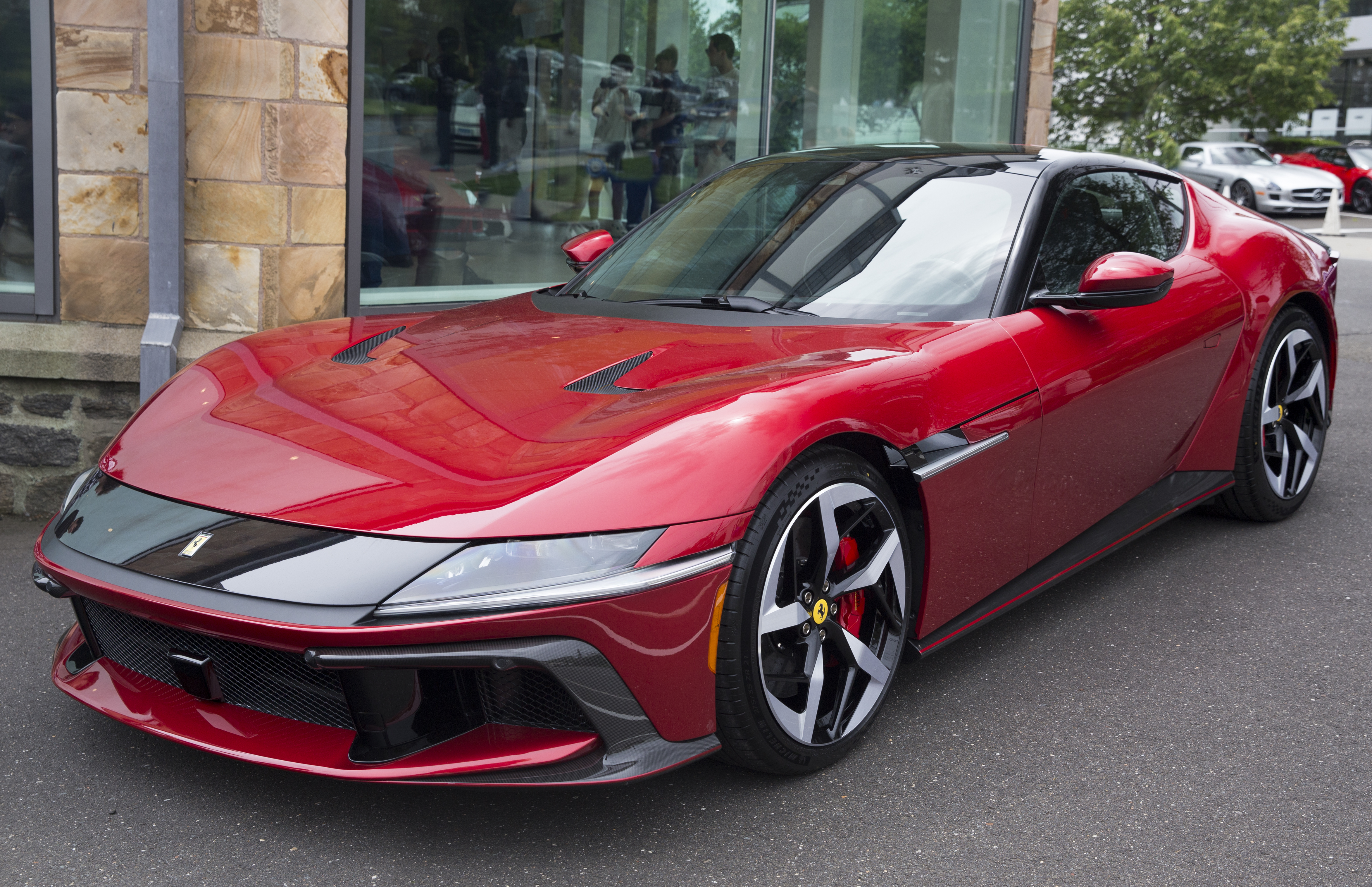
Ferrari press gallery
Ownership reality
Ferrari ownership economics differ from the rest of the ultra-luxury segment in two ways. First, depreciation behavior on the standard lineup tracks segment norms — meaningful first-three-year decline, flatter middle period — but the Special Series and Icona cars frequently appreciate from the day of delivery, sometimes substantially. Second, allocation discipline means that "the right" specification on a new Ferrari is partly defined by what the dealer recommends, not just what the buyer wants.
Standard lineup cars (296, SF90, 12Cilindri, Purosangue, and the outgoing Roma) typically depreciate 25-40% in the first three years, with significant variability based on color and option specification. Manual-transmission Ferraris from the recent era (the gated-manual 599 GTB Fiorano, roughly thirty cars; manual F430s; the last of them a 2012 California) trade at substantial premiums — the marque has not offered a manual transmission as a regular option since the early 2010s. The 458 was the first mid-engined Ferrari with no manual at all, so a gated 458 is an aftermarket conversion and prices on its own terms.
Annual service intervals are 12 months or 12,500 miles. The Genuine Maintenance program — included on cars up to seven years old — covers the scheduled service, parts, and labor. After the seven-year mark, service is quoted by the dealer rather than published to a price list, and major items — clutch, belts on older cars — sit well above a routine annual visit. Get the quote in writing before the programme lapses. A 2026 ValuePenguin insurance survey of four carriers — Hagerty among them — across ten Ferrari models averaged $448 a month, about $5,400 a year, for a 30-year-old covering 1,000 miles annually. Collector specialists came in below standard carriers.
For collector-grade examples (special-allocation cars, low-mileage 458s and 599s, the Special Series and Icona cars), insurance is typically agreed-value through Hagerty or Chubb rather than market-value through a standard carrier — a meaningful cost-and-coverage difference.
Dealer landscape
Ferrari operates an estimated 40 authorized dealers in the United States, with concentration in the same metros as the rest of ultra-luxury — Los Angeles, Miami, New York, San Francisco Bay Area, Dallas, Houston, Atlanta, Boston, Chicago, and Seattle. The dealer network is deliberately small relative to the marque's recognition; expanding it is not a strategic priority for the manufacturer.
Specialist independent service for Ferrari is meaningful in the same metros, particularly for older cars (the V8 Berlinetta line from the 1990s and 2000s, the V12 grand tourers, the front-engined 1990s-era cars). For modern lineup service while the car is in warranty or in the Genuine Maintenance window, authorized dealer service is the right choice. For older cars and out-of-warranty work, an experienced independent specialist often beats the dealer on both price and depth of marque-specific knowledge — particularly on belt-driven engines (pre-2010 V8s and V12s).
Buying advice
For new-vehicle buyers, allocation is the central reality. Ferrari does not sell from inventory the way most luxury manufacturers do; cars are built to order, dealer-assigned, and the buyer establishes a relationship with a specific dealer over time. For a first Ferrari, the productive conversation is about 296 allocation — meaningfully more relaxed than the SF90, 12Cilindri, or Purosangue. Existing relationships with the dealer are the path to the harder-to-allocate cars.
For CPO buyers, the Ferrari Approved program covers cars up to a defined age and mileage and includes a 12-month warranty extension plus a manufacturer-mandated reconditioning standard. Ferrari Approved cars typically sit at a meaningful premium over private-party pre-owned but carry the warranty backing and reconditioning, which on a Ferrari is a non-trivial value.
For pre-owned buyers, the editorial sweet spot differs by model. On the V8 Berlinetta line (488, F8 Tributo, Pista, 488 Pista Spider), four-to-six-year-old cars represent the depreciation floor for most specifications; sweet-spec examples in popular colors are starting to firm. On the V12 cars (812 Superfast and Superfast variants, 812 GTS), depreciation has been gentler and the "sweet spot" is harder to identify. The best general advice for pre-owned Ferrari is buy specification and provenance over mileage.
For collector-grade interest, the gated manual cars (the very limited gated-manual 599 GTB Fiorano, manual 360 Modenas, manual F430s in selected specifications) and the special-allocation cars (LaFerrari, Monza SP1/SP2, Daytona SP3) are the pieces that have shown the clearest signal of long-term appreciation. These markets are thinly-traded; buying advice is dealer-relationship and specialist-broker territory rather than retail.
Frequently asked questions
How does Ferrari allocation actually work?
Ferrari assigns production to dealers; dealers assign delivery slots to buyers based on a combination of existing-customer status, lineup history, market priority, and the manufacturer's read on what the buyer is likely to do with the car. For first-time buyers, allocation on the standard lineup (296) is achievable through any authorized dealer; allocation on harder cars (Purosangue, SF90 XX) and on Special Series and Icona cars is meaningfully harder and typically requires a multi-year dealer relationship.
Why do some Ferraris appreciate while most depreciate?
Standard-lineup Ferraris depreciate on the same general curve as other ultra-luxury vehicles — meaningful first-three-year decline, flatter middle period. Special Series cars (LaFerrari, the Pista variants, certain limited Speciale models) and Icona cars (Monza SP1/SP2, Daytona SP3) frequently appreciate from delivery because production volumes are deliberately constrained well below demand and allocation is tightly controlled.
Is the Purosangue an SUV?
Ferrari is deliberate in framing the Purosangue as a "four-door Ferrari" rather than an SUV. The car is a four-door, four-seat, all-wheel-drive vehicle with a naturally-aspirated V12 engine — taller than a typical Ferrari but with proportions closer to a grand tourer than to the Bentayga, Cullinan, Urus, or DBX. Marque covers it both ways: under the Ferrari brand page and in the luxury-SUV segment.
What is the Genuine Maintenance program?
Genuine Maintenance is Ferrari's included-service program covering scheduled maintenance on cars up to seven years old, regardless of mileage. The program covers the manufacturer-specified service intervals, parts, and labor at an authorized dealer. After the seven-year mark, service is an out-of-pocket cost for the owner.
Does Ferrari still build manual-transmission cars?
Ferrari has not offered a manual transmission as a regular production option since the early 2010s. The last manual-transmission Ferrari road cars were a small number of California, 599 GTB Fiorano, and final-run F430 examples specified by buyers who explicitly requested it. Used-market premiums on these cars are substantial.
Where are Ferraris built?
Every Ferrari road car is built at the Maranello, Emilia-Romagna factory — the same site since the late 1940s. Engine machining, body construction, paint, and final assembly are all Maranello operations. Some platform components and electronics are sourced from elsewhere in the supplier base, but the road-car build is fundamentally a Maranello operation.
Do I need to be a current Ferrari owner to buy a new Ferrari?
No — first-time Ferrari buyers can and routinely do order new cars. Standard lineup allocation (296) is generally achievable for first-time buyers through any authorized dealer. Allocation on the harder cars (Purosangue, SF90 XX, Special Series, Icona) is meaningfully constrained and typically requires existing-customer status and a multi-year relationship with a specific dealer.
Figures on this page carry their source. Positioning, allocation practice, and where this marque sits against its rivals are editorial judgment by The Marque Editors — informed by that data, but readings of it rather than measurements. How both are produced: methodology.