Maserati.
Italian grand-touring tradition, recently reset under the Stellantis umbrella.
- Founded1914
- HeadquartersModena, Italy
- CountryItaly
- TierLuxury
What is Maserati today?
Maserati is an Italian luxury sports-car and grand-tourer marque founded in 1914 in Bologna and headquartered in Modena, Emilia-Romagna. The company is a Stellantis subsidiary. The current lineup is anchored by the MC20 mid-engine sports car, GranTurismo and GranCabrio grand tourers, and the Grecale compact SUV. Levante, Ghibli, and Quattroporte were discontinued through 2024-2025.
Who owns Maserati?
Maserati is wholly owned by Stellantis N.V., the multinational automotive group formed by the 2021 merger of Fiat Chrysler Automobiles and PSA Group. Stellantis is publicly traded in New York, Milan, and Paris. Maserati operates with engineering autonomy in Modena. The marque is restructuring around the Nettuno V6 and Folgore electric sub-brand.
What does Maserati ownership cost?
Service is due every 12 months, and Maserati offers prepaid programmes that fix the cost in advance. Tires are a meaningful line item; the ownership calculator prices a set for the specific trim. First-year depreciation on Ghibli and Quattroporte historically ran near 48% — the Marque curve for the Ghibli is the steepest of any marque covered here — among the steepest in luxury — and was a defining ownership reality of the marque through the 2010s. Newer MC20 and Grecale follow more conventional curves.
Where do you buy a Maserati?
Maserati sells through authorized US dealers only, often co-located with Alfa Romeo or Stellantis Premium showrooms. The dealer network was rationalized through 2023-2024 as the marque restructured. The Maserati Approved CPO program covers two-to-five-year-old cars with factory warranty extension. Direct ordering runs through dealers. Marque lists four Maserati dealers across its ten covered metros; Maserati's own dealer locator is the current list for the rest of the country.
Should you buy a new or pre-owned Maserati?
For first-time Maserati buyers, three-to-five-year-old Levante or Ghibli examples are inexpensive entry points but carry the segment's steepest depreciation history. The newer MC20 and Grecale represent the cleaner buying proposition at lower discount-to-MSRP. Avoid first-year examples; favor warranty-extension CPO from authorized dealers over independent inventory.
History
The Maserati brothers — Alfieri, Ettore, Ernesto, and later Bindo — founded Officine Alfieri Maserati in Bologna in 1914, initially as a racing-and-engineering shop before the first road cars in the late 1920s. The Trident logo was designed by Mario Maserati, modeled on the trident in the Fountain of Neptune in Bologna's central piazza. The marque's racing history through the 1930s and into the 1950s is materially significant — Juan Manuel Fangio won the 1957 Formula 1 World Championship in a Maserati 250F.
Through the second half of the 20th century the company moved through multiple ownership transitions — Orsi family, Citroën in the late 1960s, De Tomaso through the 1970s and 1980s, then Fiat from 1993. The Fiat era stabilized the company commercially and integrated Maserati into what would become the Fiat-Chrysler-Stellantis group; for much of the 2000s and 2010s, Maserati shared platforms and engines with the broader Group, particularly with Ferrari (which built the V8 used in the Quattroporte and GranTurismo of that era).
The current product strategy — Nettuno-V6-anchored, Folgore-electric-extended, lineup reduced from seven nameplates to four core models — represents a substantial reset. The Ghibli (mid-size sedan) and Levante (mid-size SUV) ran out of production through 2024, and the next-generation Quattroporte program has been deferred and re-scoped as a likely EV-only flagship. The MC20 (2020), the second-generation GranTurismo (2022), and the Grecale (2022) represent the post-reset lineup in its current form.
Anchored on the Maserati Ghibli — built through 2024 and not replaced.
Source: Industry composite estimate (CarEdge / iSeeCars / KBB), 2026. The steepest curve of any marque covered here, and the sources disagree on how steep: CarEdge puts the brand at roughly 71% lost over five years (about 29% residual), iSeeCars at 63% on the Ghibli and Levante (about 37%). The series above runs between them. Almost all of the loss lands in year one — verify against current dealer offers.
Positioning
Maserati sits in a distinctive segment slot — more attainable than Ferrari and Lamborghini, more luxury-leaning than Porsche, and structurally separate from the German luxury-sedan-and-SUV mainstream (Mercedes, BMW, Audi). The post-reset lineup is built around three pillars: the MC20 as the mid-engine sports-car halo, the GranTurismo / GranCabrio as the grand-tourer line, and the Grecale as the SUV volume car.
The Nettuno V6 — a Maserati-developed 3.0-liter twin-turbocharged V6 with Formula 1-derived pre-chamber combustion technology — is the marque's most consequential engineering investment of the post-Ferrari-engine era. It powers the MC20, the GranTurismo Modena and Trofeo, and the Grecale Trofeo. The Folgore designation marks the all-electric variants — Folgore versions exist of the GranTurismo, GranCabrio, MC20, and Grecale — built on Stellantis-Group EV platforms with Maserati-specific calibration.
Current lineup
MC20 / MC20 Cielo / MC20 Folgore
The mid-engine sports-car halo — the Nettuno V6 in its most uncompromised application.
The MC20 launched in 2020 as the marque's return to mid-engine sports-car production after the MC12 of the early 2000s. Carbon-fiber monocoque, Nettuno V6 producing roughly 620 horsepower, eight-speed dual-clutch gearbox. The Cielo is the targa-roof variant; the Folgore is the all-electric version, sharing the carbon monocoque but with three electric motors and a battery pack. The MC20 is the technical-statement car of the lineup — production is constrained relative to the GranTurismo and Grecale.
GranTurismo / GranTurismo Folgore
The grand-tourer flagship — front-engine V6 in Modena and Trofeo, all-electric in Folgore.
The second-generation GranTurismo launched in 2022 as a 2+2 grand tourer available in three powertrains: the Modena (lower-output Nettuno V6, all-wheel drive), the Trofeo (higher-output Nettuno V6, all-wheel drive), and the Folgore (three-motor all-electric, all-wheel drive). The GranTurismo is the most editorially flexible car in the lineup — buyers can choose between the V6 grand-tourer signature and the Folgore as one of the segment's most credible all-electric grand-tourer specifications.
GranCabrio / GranCabrio Folgore
The convertible variant of the GranTurismo — Trofeo and Folgore specifications.
The GranCabrio is the soft-top convertible variant of the second-generation GranTurismo. Available in Trofeo (Nettuno V6) and Folgore (electric) specifications. It carries the GranTurismo's editorial profile in a convertible package and is positioned against the Continental GT Convertible, the SL 63, and the Vantage Roadster.
Grecale (GT, Modena, Trofeo, Folgore)
The compact luxury SUV — the volume car of the lineup.
The Grecale launched in 2022 as the marque's entry into the compact luxury SUV segment. Available in four specifications: GT (mild-hybrid four-cylinder), Modena (mild-hybrid four-cylinder, higher-output), Trofeo (Nettuno V6), and Folgore (all-electric). The Grecale is the closest direct cross-shop with the Porsche Macan and BMW X3 M-line and is the most accessible entry point to the marque.
Levante / Quattroporte / Ghibli (last production years, in pre-owned market)
The previous-generation lineup — discontinued new but actively traded in the pre-owned market.
The Ghibli (mid-size sedan), Levante (mid-size SUV), and the previous-generation Quattroporte (full-size sedan) ran out of production through 2024. All three carry meaningful pre-owned-market presence, with the Levante GTS and Trofeo specifications (Ferrari-built V8) representing the most editorially interesting variants of the outgoing lineup. The next-generation Quattroporte program has been deferred and is expected to return as an EV-only flagship later in the decade.
Maserati press gallery
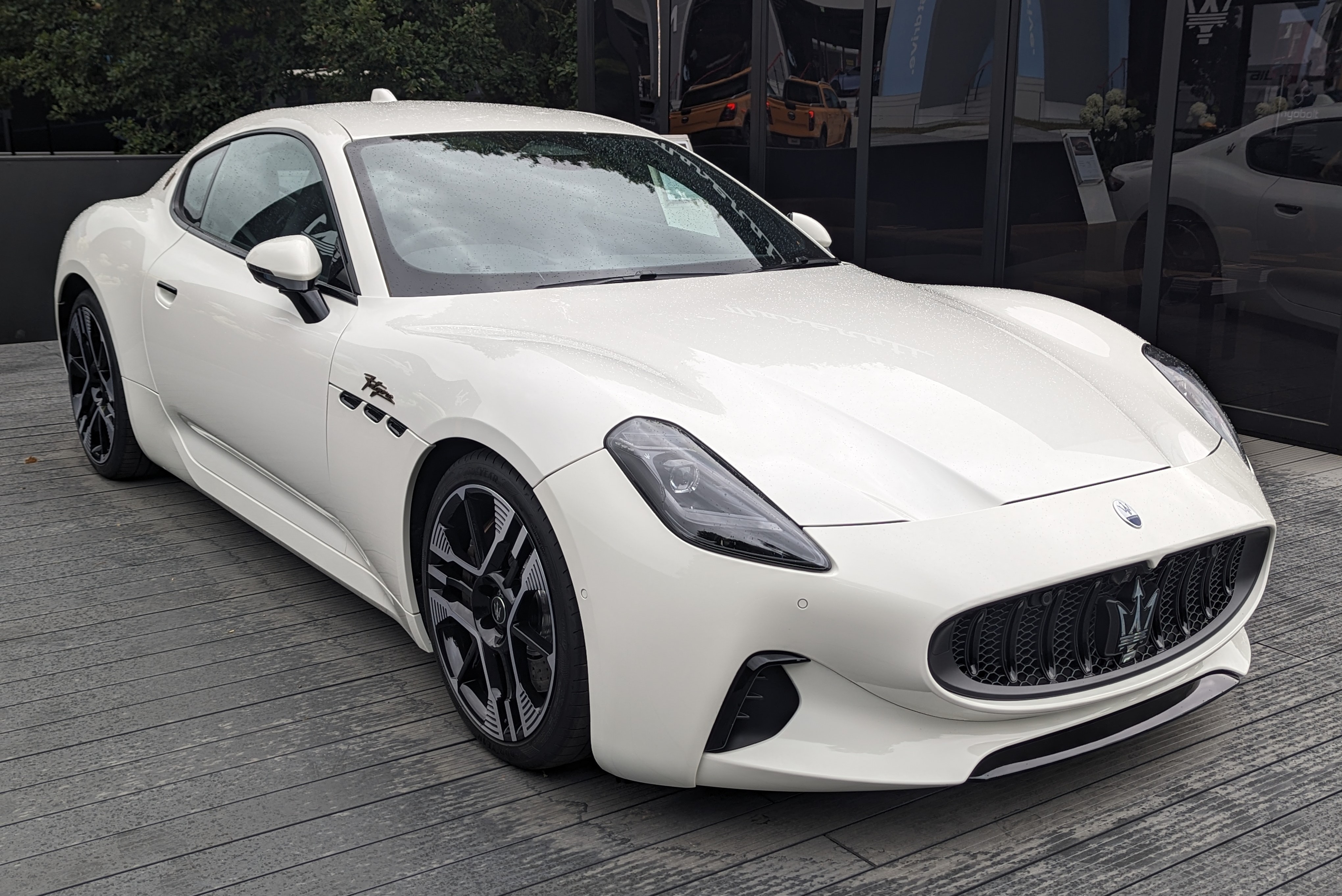
GranTurismo Folgore — all-electric flagship; first EV in the second-generation GranTurismo lineup.Photo: Calreyn88 via Wikimedia Commons (CC0 — public domain) · Source 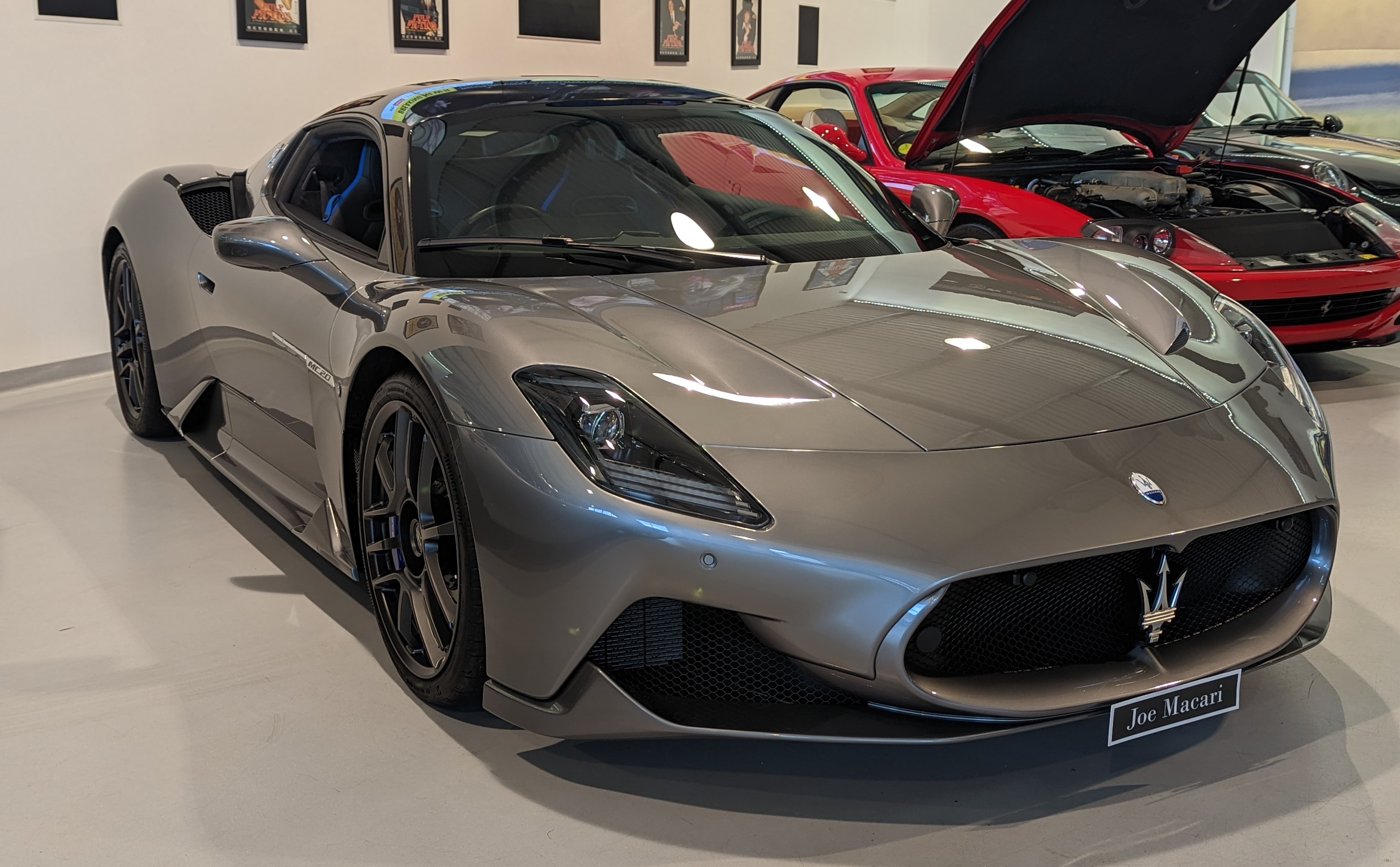
MC20 — mid-engine supercar with the in-house Nettuno V6 (pre-chamber combustion, F1-derived).Photo: Calreyn88 via Wikimedia Commons (CC BY-SA 4.0) · Source
Ownership reality
Maserati ownership economics historically include sharper depreciation than the equivalent Porsche or Mercedes-AMG specification. New-lineup cars (MC20, second-generation GranTurismo, Grecale) are still establishing their depreciation baseline; pre-reset cars (Ghibli, Levante, previous-generation Quattroporte, original GranTurismo) have depreciated 50-65% over the first three-to-five years across most specifications. The depreciation curve has historically been the marque's pre-owned-buyer opportunity.
Annual service intervals are 12 months or 10,000 miles for the Nettuno-V6 cars and the Grecale four-cylinder. The Maserati Premium Plan covers a defined three-year window from new-car purchase, with extended service plans available at point of purchase. Out-of-warranty service is quoted per visit at an authorized dealer. The MC20 sits materially above the volume lineup, reflecting the carbon-fiber monocoque and the more constrained service network.
Insurance is priced on the driver and the ZIP code rather than on the car alone, and no rate survey publishes Maserati premiums — a written quote is the only figure worth planning against. The MC20 sits higher again, closer to the mid-engine sports-car norm. The Folgore (all-electric) variants are generally insured at lower rates than the equivalent V6 specifications.
The Stellantis-Group parts catalog has a quiet implication for ownership: routine consumables and certain electrical components on the Grecale, Ghibli, and Levante overlap with the broader Group catalog — meaningfully helpful for parts availability and for an independent specialist's ability to service the volume models without the authorized-dealer parts markup.
Dealer landscape
Maserati operates an estimated 50-55 authorized dealers in the United States, with the network running through both stand-alone Maserati dealerships and dual-marque arrangements (typically with Alfa Romeo or another Stellantis-Group luxury franchise). The dealer footprint covers the major metros — Los Angeles, Miami, New York, San Francisco Bay Area, Houston, Dallas, Atlanta, Boston, Chicago, Seattle — plus several secondary markets where the marque has historical depth (Naples, Greenwich, Phoenix, Charlotte).
Specialist independent service for older Maserati cars (the Ferrari-engined Quattroporte and GranTurismo of the 2000s and 2010s, the original GranTurismo coupe, the early Ghibli) is meaningful in the same metros. The Ferrari-V8 cars in particular are serviced by a different specialist community than the Nettuno-V6 cars; the Ferrari-engined service network has more depth on cam-belt and timing-chain work specific to that engine family.
Buying advice
For new-vehicle buyers, the Grecale and GranTurismo are generally available through any authorized dealer with reasonable lead times. The MC20 is the constrained slot in the lineup — production is meaningfully smaller than the volume cars and allocation typically requires a more extended dealer conversation. The Folgore (all-electric) variants have generally been available in stock or near-stock at most dealers as the marque builds the EV order book.
For CPO buyers, the Maserati Approved program covers cars up to a defined age and mileage and includes a 24-month warranty extension plus a manufacturer-mandated reconditioning standard. Approved cars sit at a meaningful premium over private-party pre-owned, but the warranty extension on a Ferrari-engined Quattroporte or Levante GTS is, on the math, worth more than the premium reflects — those engines carry meaningfully higher out-of-warranty service exposure than the Nettuno V6.
For pre-owned buyers, the editorial sweet spot on the post-reset lineup is a two-to-three-year-old GranTurismo Modena or Trofeo with documented service history and a sensible factory specification. On the previous-generation lineup, the Levante GTS and Trofeo (Ferrari V8) represent the most interesting collector-leaning pre-owned buys; the Ghibli S Q4 and the previous-generation Quattroporte GTS carry meaningfully less long-term editorial appeal but trade at substantial discounts to MSRP.
For collector-grade interest, the MC12 (limited-production, Ferrari Enzo-derived, early 2000s) and the original GranTurismo MC Stradale are the recent collector pieces; both are thinly-traded and dealer-relationship territory. The MC20 program is too new to read as collectible; first-edition cars and Cielo-roof early-production examples may eventually firm but the depreciation curve on the standard MC20 is not yet established.
Frequently asked questions
Who owns Maserati?
Maserati is a wholly-owned subsidiary of Stellantis NV, the multinational automotive group formed by the 2021 merger of Fiat Chrysler Automobiles and PSA Group. The Modena factory and engineering organization remain Italian and operate with material autonomy on product strategy, but capital, platform, and electrification investment run through the Stellantis structure.
What is the Nettuno V6?
The Nettuno is a Maserati-developed 3.0-liter twin-turbocharged V6 engine featuring pre-chamber combustion technology adapted from Formula 1. It produces 620+ horsepower in the MC20, the GranTurismo Trofeo, the GranCabrio Trofeo, and the Grecale Trofeo, in tunes ranging from roughly 530 horsepower (GranTurismo Modena) to 630 horsepower (MC20). It is the marque's most consequential in-house engineering project of the post-Ferrari-engine era.
What is "Folgore"?
Folgore is Maserati's designation for all-electric powertrains. Folgore variants exist of the GranTurismo, GranCabrio, MC20, and Grecale — each built on Stellantis-Group EV platforms with Maserati-specific calibration. The Folgore lineup represents the marque's electrification strategy and is positioned to anchor the post-2025 product roadmap as the next-generation Quattroporte and other future models move toward EV-only specifications.
Why were the Ghibli, Levante, and Quattroporte discontinued?
Maserati restructured the lineup around the Nettuno V6 and the Folgore EV strategy through 2024-2025, retiring the older platforms (Ghibli, Levante, previous-generation Quattroporte) that had been built on Fiat-Chrysler-era architecture and powertrains. The next-generation Quattroporte program has been publicly deferred and is expected to return later in the decade as an EV-only flagship; there is no announced successor to the Ghibli or Levante in the current product roadmap.
How does Maserati depreciation compare to Porsche or Mercedes-AMG?
Sharper, historically. Pre-reset Maseratis (Ghibli, Levante, previous-generation Quattroporte, original GranTurismo) frequently traded at 50-65% off MSRP at the three-to-five-year mark, well below the equivalent Porsche or AMG specification. The post-reset lineup (MC20, second-generation GranTurismo, Grecale) is still establishing its depreciation baseline; early-production data suggests the curve may be closer to the segment median, but the multi-year track record is not yet in.
Where are Maseratis built?
Most Maserati production runs through the Modena factory (MC20) and the Mirafiori plant in Turin (GranTurismo, GranCabrio, GranTurismo Folgore, GranCabrio Folgore). The Grecale is built at the Stellantis Cassino plant in Lazio. The previous-generation Levante was built at Mirafiori; the previous-generation Ghibli and Quattroporte were built at the Grugliasco facility, which has since been repurposed within the Stellantis manufacturing footprint.
Figures on this page carry their source. Positioning, allocation practice, and where this marque sits against its rivals are editorial judgment by The Marque Editors — informed by that data, but readings of it rather than measurements. How both are produced: methodology.