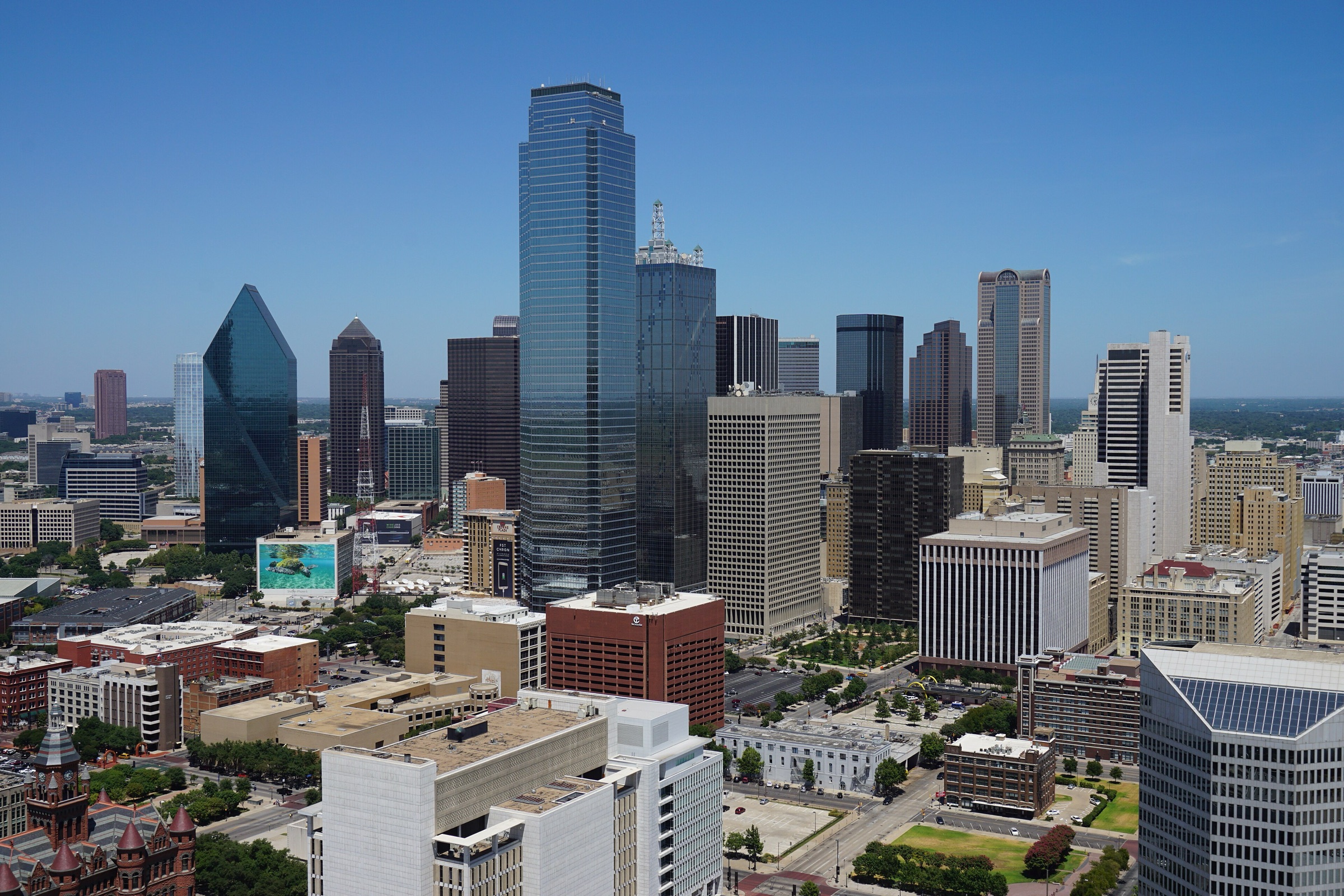
Luxury cars in Dallas.
Dallas-Fort Worth is one of the fastest-growing luxury markets in the country, with Highland Park and Preston Hollow concentrating ultra-luxury demand.
- RegionSouth
- StateTX
- Authorized dealers4
- Marques represented4
Market shape
Greater Dallas-Fort Worth is the country's fourth-largest metro by population and one of the most-established luxury-car markets outside the coastal corridors. The wealth profile is more diversified than Houston's — the local economy combines banking and financial services (Bank of America, JPMorgan Chase, Goldman Sachs all run major Dallas operations), corporate headquarters (AT&T, ExxonMobil, McKesson, Charles Schwab among the major recent relocations), real estate, and a substantial healthcare and technology presence. The buyer base reflects that diversification: the Dallas market is more balanced across SUV, sedan, and supercar specifications than the Houston pattern.
Demand concentrates in Highland Park, Preston Hollow, and University Park — the established old-money zip codes that have anchored the Dallas wealth geography for decades. Newer wealth in Frisco, Plano, and Westlake (driven substantially by the corporate-relocation pattern of the past 15 years) has built a meaningful suburban supplement that runs along the Dallas North Tollway corridor north of LBJ Freeway. The Westlake / Vaquero cluster (between Dallas and Fort Worth) is a more discrete wealth pocket with its own dealer-relationship pattern.
Used-market liquidity in Dallas is meaningful and operates with a deep regional cross-shop into the broader Texas market (Houston, Austin, San Antonio), the lower-Midwest (Oklahoma, Arkansas, Louisiana), and increasingly the corporate-relocation source markets (California, New York, Illinois). Texas's no-state-income-tax structure and uniform motor vehicle sales tax (6.25% with no local addition) make the state a regional pre-owned aggregator for the broader Southwest and lower-Midwest regions.
Driver culture
Dallas driving conditions favor luxury cars in a way similar to Houston but with meaningfully more drivable hours per year. Year-round drivability holds, with the summer heat-and-humidity profile less severe than Houston's — peak summer temperatures reach the high 90s but humidity is structurally lower. Convertibles are usable as daily drivers across most of the calendar; PPF and ceramic-coating specification is common but less universally-essential than in Houston.
The freeway network through DFW is among the most-developed in the country — the Dallas North Tollway, the President George Bush Turnpike (Loop 12 outer ring), Interstate 635 (LBJ Freeway), Interstate 35 north-south spine, Interstate 30 east-west spine, and multiple radial arteries collectively support a high-mileage ownership pattern. Dallas drivers commonly cover 15,000-22,000 miles per year on a luxury car, materially above national luxury-car averages.
Tornado-season driving and storage (April through June) is the regional weather concern that doesn't exist in coastal markets. Hail damage is a meaningful insurance-and-storage consideration; covered or indoor storage is functionally standard for high-end inventory across the metro. Driving roads near Dallas are limited in the immediate area; the Texas Hill Country (three-hour drive south toward Austin and Fredericksburg) is the established regional driving destination, with the Highway 16 / 337 / 173 / Three Sisters loop sitting closer to Dallas than to Houston.
Dealer landscape
Dallas has authorized-dealer presence for every Marque-covered marque, with the densest concentration along the Dallas North Tollway through the Park Cities and along Lemmon Avenue near Love Field. The two dominant local dealer groups — the Park Place organization (now part of the Asbury Automotive Group) and the Sewell Automotive Companies — collectively operate the meaningful share of the new-vehicle activity. Park Place runs Bentley, Rolls-Royce, McLaren, Maserati, and several other ultra-luxury franchises on the Lemmon Avenue corridor; Sewell runs an extensive Mercedes-Benz, Lexus, Audi, and Porsche footprint with a major Mercedes-Maybach Studio presence.
Suburban dealer activity concentrates in Plano along the Dallas North Tollway (Frisco for Mercedes-Benz, Plano for Lamborghini and Aston Martin), and in the Mid-Cities corridor (Grapevine, Southlake) where several luxury franchises operate alongside the established Fort Worth dealer footprint. Highland Park itself has limited in-zip-code dealer presence given the residential zoning; most Highland Park buying activity routes through the surrounding Lemmon Avenue and Tollway dealers.
For new-vehicle allocation, the Park Place and Sewell organizations' multi-marque structures means existing-customer status across one franchise often produces allocation conversation depth on the harder allocations within the same group. Sewell in particular has a multi-decade reputation for customer-experience standards that defines the regional luxury-car retail expectation. CPO inventory is competitive across the volume marques and benefits from the Texas regional cross-shop.
Authorized dealers in Dallas
Manufacturer-authorized dealerships. Click through for current inventory and contact details.
Bentley Dallas
2425 W. Northwest Highway
Dallas, TX 75220McLaren Dallas
5300 Lemmon Avenue
Dallas, TX 75209Park Place Dealerships group.
Pagani of Dallas
601 S. Central Expressway
Richardson, TX 75080Porsche Plano
5924 West Plano Parkway
Plano, TX 75093
Independent specialists
The Dallas independent-specialist ecosystem is well-developed across the established marques — Boardwalk and Park Place service operations sit at the dealership-affiliated tier, with a substantial layer of independent specialists for air-cooled Porsche, classic British (Bentley, Rolls-Royce, Aston Martin, Jaguar), and modern Italian (Ferrari, Lamborghini, Maserati). For out-of-warranty service, a Dallas buyer typically has credible specialist alternatives to the authorized dealer.
Pre-purchase inspection is a meaningful service category given the volume of regional pre-owned transactions. The DFW market's status as a regional pre-owned aggregator means a substantial share of the local inspection demand comes from out-of-state buyers shipping cars in from Dallas; specialist inspection capacity has grown to match. For any pre-owned purchase being made into the metro, a Dallas-based specialist inspection is often the right risk-management step before closing.
Events and community
The regional event calendar centers on the Dallas Auto Show (annual, Kay Bailey Hutchison Convention Center, late October to early November) — primarily a volume-luxury and mainstream show but with some high-end participation. The Concours d'Elegance of Texas (held at various Hill Country venues in different years) is the more-developed regional collector event, with a smaller but more-curated participant base than the Houston Pin Oak event.
Locally, the cars-and-coffee culture is anchored by the Sewell Cars and Coffee gathering (one of the most-developed dealer-hosted Sunday meets in the country, held at Sewell Lexus Dallas), and various Park Place customer-and-community events that draw the high-end buyer base specifically. The Dallas / Fort Worth distinction is meaningful — Fort Worth has its own independent event-and-collector culture anchored by the Cattle Baron's and various TCU-area events, with limited overlap with the Dallas-centric calendar.
The Pebble Beach Concours d'Elegance and Monterey Car Week (mid-August, California) draws meaningful Dallas participation despite the distance — the Dallas private-aviation infrastructure makes the West Coast event calendar substantially more accessible for the active collector segment than for buyers based in markets without that infrastructure depth.
Local buying notes
Texas has no state income tax, which structurally shifts the multi-year ownership-cost math relative to high-tax coastal metros. The state motor vehicle sales tax is 6.25% applied to the purchase price, with no local-municipal addition. Combined-rate exposure is materially lower than in California, New York, or Illinois on a substantial purchase. The corporate-relocation wave of the past 15 years has been substantially driven by exactly this tax structure and is one of the operational realities of the modern Dallas economy.
Texas registration is annual and structurally simple — fee-based on vehicle weight class with a state inspection requirement. The compliance burden is materially lower than the California Vehicle License Fee or New York City use-tax processes. Some out-of-state buyers structure ownership through Texas registration; this is an established pattern with known structuring requirements that should be reviewed with registration counsel.
Hail-and-storm damage is a meaningful local diligence concern on pre-owned purchases. Tornado-season hail events through April-June can produce significant inventory of cars with reconditioned hail damage; specialist pre-purchase inspection that includes paint-thickness measurement and panel-survey review is the right diligence step on any DFW-region pre-owned purchase. Hail-comprehensive insurance coverage is meaningfully more expensive than in non-tornado-belt markets and is a real cost-of-ownership line item.
Brands available in Dallas
- Bentley
- Rolls-Royce
- Ferrari
- Lamborghini
- McLaren
- Aston Martin
- Porsche
- Maserati
- Bugatti
- Pagani
- Koenigsegg
- Mercedes-Maybach
- Mercedes-AMG
- Range Rover
Frequently asked questions
How does the Dallas luxury-car market compare to Houston?
More diversified by industry, more balanced across vehicle specifications, and slightly more accessible by climate. Houston's market is anchored by energy-sector wealth and skews toward SUV and large-sedan specifications; Dallas's wealth is more diversified across banking, corporate headquarters, real estate, and healthcare, and the buyer base is more evenly distributed across SUV, sedan, and supercar specifications. Both share the no-state-income-tax structure and the same uniform motor vehicle sales tax.
What are the Park Place and Sewell organizations?
The two dominant local dealer groups. Park Place (now part of Asbury Automotive Group) operates Bentley, Rolls-Royce, McLaren, Maserati, and other ultra-luxury franchises along the Lemmon Avenue corridor. Sewell Automotive Companies operates a substantial Mercedes-Benz, Lexus, Audi, and Porsche footprint with major Mercedes-Maybach Studio presence. Sewell in particular has a multi-decade reputation for customer-experience standards that defines the regional luxury-car retail expectation.
Where do Dallas-area buyers concentrate by zip code?
Highland Park, Preston Hollow, and University Park are the established old-money concentrations inside the city core. Newer wealth concentrates in Frisco, Plano, and Westlake along the Dallas North Tollway and the Mid-Cities corridor — these areas have grown substantially through the corporate-relocation wave of the past 15 years. The Westlake / Vaquero cluster between Dallas and Fort Worth is a more discrete pocket with its own dealer-relationship pattern.
What is Texas motor vehicle sales tax?
Texas applies a state-uniform 6.25% motor vehicle sales tax on the purchase price, with no local-municipal addition. Combined exposure on a substantial purchase is materially lower than in California, New York, or Illinois. Annual registration is fee-based on vehicle weight class with a state inspection requirement; the compliance burden is meaningfully lower than the California VLF structure.
How does tornado season affect luxury-car ownership in Dallas?
Hail damage from tornado-season storms (April through June) is a meaningful insurance-and-storage consideration. Covered or indoor storage is functionally standard for high-end inventory across the metro. Hail-comprehensive insurance coverage costs measurably more than in non-tornado-belt markets. On pre-owned purchases, specialist pre-purchase inspection that includes paint-thickness measurement and panel-survey review is the right diligence step to identify reconditioned hail damage that may not appear in standard title-history reports.
What are the best driving roads from Dallas?
The Texas Hill Country (three-hour drive south toward Austin and Fredericksburg) is the established regional driving destination — Highway 16, Highway 337, Highway 173, and the Three Sisters loop (FM 335 / 336 / 337) collectively form the area's strongest driving region. Dallas-area buyers are slightly closer to the Hill Country than Houston-area buyers, which produces a measurable difference in weekend drivability for that destination.
Figures on this page carry their source. Market character, dealer-group behavior, and how this metro compares with others are editorial judgment by The Marque Editors — informed by that data, but readings of it rather than measurements. How both are produced: methodology.