Vision BMW Alpina: what the BMW takeover means for buyers
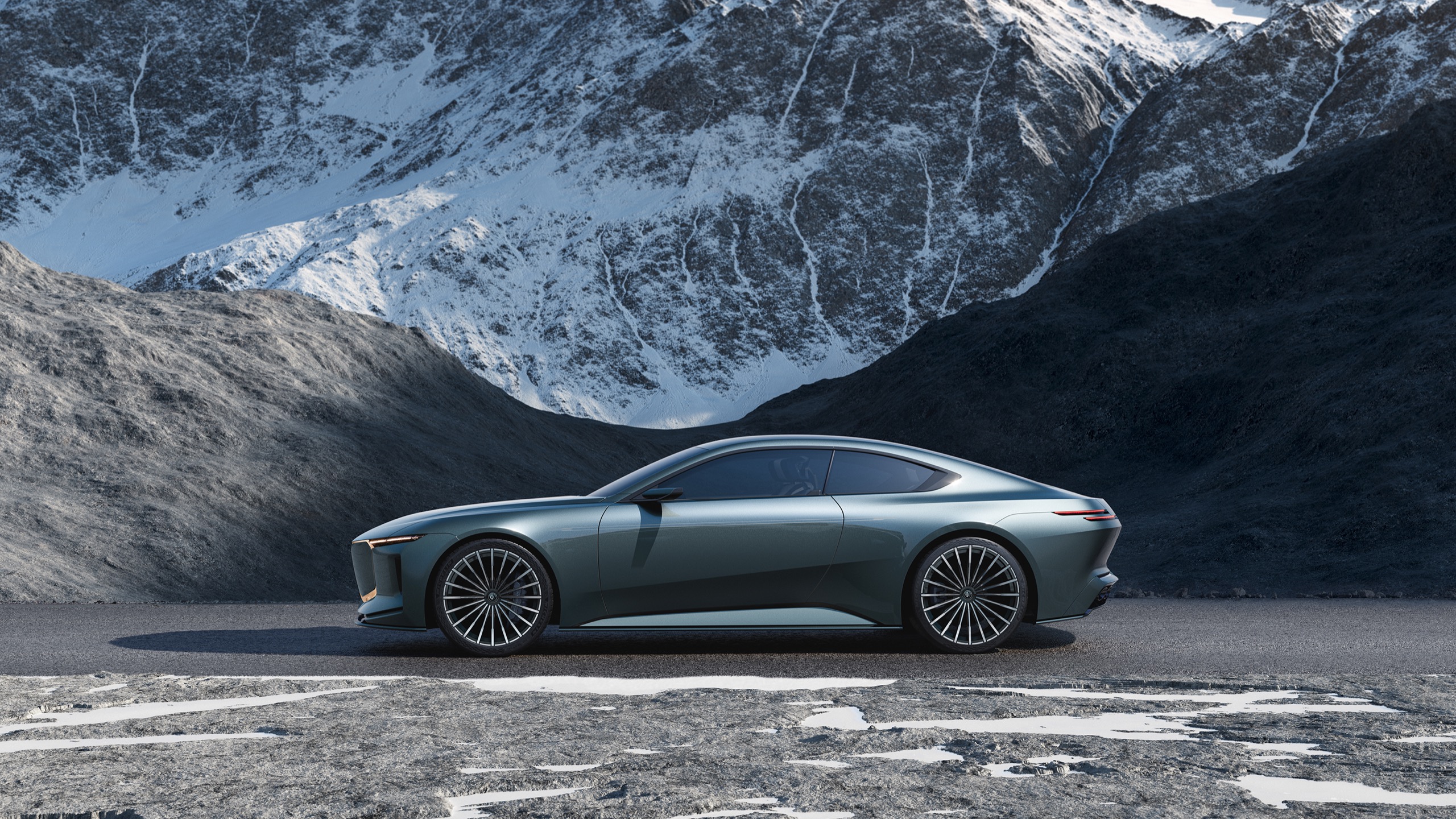
On 15 May 2026, at the Concorso d'Eleganza Villa d'Este on the shore of Lake Como, BMW revealed the Vision BMW Alpina — a design study for a large luxury coupé, and the most concrete statement yet of what Alpina becomes now that it belongs to the BMW Group. It is a concept car, not a production model: a long, low, V8-powered coupé measuring 5,200 mm (204.7 inches) nose to tail, riding on 20-spoke wheels of 22 inches at the front and 23 at the rear, with a three-dimensional reinterpretation of BMW's kidney grille set into a shark-nose front. BMW gave it a three-word title — Speed, Refined — and that is, fairly, the brief.
The concept itself is the smaller story. The larger one is the context. The Vision BMW Alpina is the first Alpina shown since the marque stopped being an independent manufacturer and became a brand inside the BMW Group — the end of a sixty-year arrangement, and the start of something the company is positioning deliberately upmarket, in the gap between BMW and Rolls-Royce. For anyone who owns an Alpina, is considering one, or simply tracks how the luxury end of the market is organized, the reveal raises three specific questions: what the takeover actually changed, what the concept signals about the cars to come, and what now happens to the Alpinas built across six decades of independence. This piece works through each.
The concept, briefly
The verifiable details, as disclosed by BMW at reveal and corroborated by the outlets that covered the Villa d'Este unveiling:
- Status. A design study, not a production car. BMW has confirmed it previews a first Alpina production model — inspired by the BMW 7 Series — due to launch in 2027 (BMW, official).
- Powertrain. A V8 engine, tuned for the exhaust character BMW describes as "rich and deep at low speed, sonorous at high revs." Output, torque and transmission were not disclosed at reveal (BMW, official).
- Dimensions. A length of 5,200 mm (204.7 inches) — between the current BMW 5 Series and 7 Series. Width, height and wheelbase were not published.
- Wheels. The 20-spoke wheel, an Alpina signature since 1971, in 22-inch front and 23-inch rear sizes.
- Exterior. A shark-nose front with a three-dimensional, illuminated kidney grille; a "speed" feature line set at a six-degree incline running the length of the body; modernized Alpina Deco-lines applied beneath the clear coat; warm-white daytime running lights; and a four-pipe elliptical exhaust. The ALPINA name appears as a machined, polished-metal element on the front apron.
- Interior. Full-grain leather sourced from Alpine-region producers, crystal control elements, watch-grade metal finishing, and a self-deploying glass bottle with engraved BMW Alpina crystal glasses. The cabin uses BMW's Panoramic iDrive display with a dedicated passenger screen.
- Reveal. 15 May 2026, Concorso d'Eleganza Villa d'Este, Lake Como, Italy.
Sixty years of Alpina
Alpina was founded in 1965 in Buchloe, Bavaria, by Burkard Bovensiepen. It began by tuning BMWs and, from the late 1970s, built and sold complete cars of its own, type-approved as a separate manufacturer rather than badged as modified BMWs. The Alpina B7 coupé of that era, based on the BMW E24 6 Series, marked the turn toward the luxury-performance positioning the brand has held ever since.
What separated Alpina from BMW's own M division was never speed alone. The brand's defining idea, repeated consistently across sixty years, is that speed and comfort are complementary rather than competing — that a fast car can also be quiet, long-legged and beautifully trimmed, and that the buyer should not have to choose between the two. In practice that meant gentler tuning than M, taller gearing built for unhurried high-speed distance, hand-finished interiors, and a small annual volume. An Alpina was the connoisseur's fast BMW: less conspicuous than an M car, more specific in its choices, and built in numbers that made each one close to bespoke.
Two visual signatures from that history survive intact on the Vision concept. The 20-spoke wheel has been an Alpina constant since 1971. The Deco-line — the fine multi-tone pinstripe that runs along the flanks — has been part of the brand since 1974. Their presence on a 2026 concept car is not nostalgia for its own sake; it is BMW signaling that the visual vocabulary of the independent brand carries forward rather than being reset.
What the takeover actually changed
BMW and the Bovensiepen family agreed the handover of the Alpina brand in 2022. Under that agreement, the independent company — Alpina Burkard Bovensiepen GmbH — continued building Alpina-badged cars through the end of 2025, and from 2026 the ALPINA brand belongs wholly to the BMW Group. Robb Report reports that BMW took full control roughly five months before the Villa d'Este reveal.
The distinction that matters to a buyer is not corporate. It is what the word "Alpina" now describes. Until the end of 2025, an Alpina was a low-volume car engineered and finished by an independent manufacturer, type-approved in its own right, and sold and serviced through BMW's network under a long-standing commercial arrangement. From 2026, "BMW Alpina" is a BMW Group brand — developed in-house, by BMW's own design and engineering teams, and positioned by BMW. The name is continuous. The thing it names is not the same thing.
One practical point reassures owners of the older cars. Alpinas were always sold, warranted and serviced through BMW's own dealer network — that was the nature of the arrangement, not a courtesy — so an independent-era Alpina is not service-orphaned by the takeover. The cars remain inside the same retail and workshop system they were bought into. What is harder to predict over a long ownership horizon is parts: components unique to the independent Alpina's bespoke specification depend on BMW's continued support of a discontinued product line, which is worth factoring into any decision to keep one of these cars for the very long term.
BMW has been explicit about where the brand now sits. Alpina is intended to occupy the space between the core BMW range and Rolls-Royce — a high-end, lower-volume marque below Rolls but above a fully-specified BMW. That is a meaningful move. The independent Alpina was a parallel interpretation of a BMW; the BMW-owned Alpina is being built as a distinct rung on the group's ladder. The Vision concept is the first public articulation of what that rung looks like.
What the concept signals
A concept car is a statement of intent, and the Vision BMW Alpina makes several worth reading closely.
The first is the body. BMW has confirmed the production car will be inspired by the 7 Series — BMW's full-size luxury sedan — yet chose to introduce the brand with a coupé. That is deliberate. A halo coupé sets a register; it states the character of a brand before the actual product arrives. The concept is not the car a buyer will be able to order. It is the argument for the cars that follow it.
The second is the powertrain. The concept is V8-powered, with combustion given pride of place at a moment when most halo concepts from luxury makers are electric. BMW describes the engine through its sound — "rich and deep at low speed, sonorous at high revs." For a brand whose identity was built on the unhurried delivery of speed, leading with a V8 rather than a battery is a statement about character, and about which buyers Alpina intends to keep.
The third is the interior. The crystal control surfaces, the watch-grade beveling on the metalwork, the full-grain leather specified from Alpine-region tanneries, the self-deploying crystal glassware in the rear console — none of that vocabulary belongs to a fast BMW. It belongs to the Rolls-Royce end of the BMW Group. Adrian van Hooydonk, head of BMW Group Design, framed the concept as showing how Alpina's qualities "can be expressed with discipline and modernity." Maximilian Missoni, who leads design for BMW's midsize and luxury cars and for BMW Alpina, said "every detail reflects substance: in engineering, in materials, and in the story it tells." Past the launch language, the message is consistent: BMW is building Alpina as a genuine luxury brand, not a trim level.
What happens to the independent-era cars
For the reader who already owns an Alpina, or is shopping the used market for one, the most consequential effect of the takeover has nothing to do with the concept car. It is that the cars built through the end of 2025 are now a closed set — the last Alpinas of the independent era.
A clean historical line has been drawn. On one side are six decades of cars engineered and hand-finished by the Bovensiepen company in Buchloe and type-approved as Alpinas in their own right. On the other is whatever BMW builds from here. The two will not be confused, and over time the market for a discontinued independent marque tends to sort itself around exactly that line: original-era cars with documented provenance treated as one category, successor-brand cars as another.
It is worth being precise about what this does and does not mean. It does not mean every independent-era Alpina is now an appreciating asset. Alpina was a low-volume manufacturer, but its recent cars — the last B7 sedans, the XB7 — were built in numbers far closer to ordinary production than to a limited edition, and most will follow a normal depreciation curve for some years yet. Brand discontinuity is a factor collectors weigh; it is not a guarantee they price in.
What it does change is that the provenance question now has a fixed answer. An Alpina built in 2025 is, by definition, a last-of-the-independent-era car; one built in 2028 is not. For a buyer, the practical consequence is documentation. The Alpina production number, the original build specification, the full service history — the paperwork that places a specific car on the correct side of that line — is what will separate examples as the two eras settle into distinct markets. If you own a late independent-era car, that documentation is worth assembling now, while it is straightforward to.
Where it sits for a luxury-car buyer
Marque's readers tend to shop a tier above Alpina's historical position — the Bentleys, the Rolls-Royces, the front-engined Ferraris. So the fair question is where a BMW-owned Alpina now fits against those cars.
Historically, it did not compete with them at all. An Alpina was a fast, refined BMW — priced above a standard BMW, well below a Bentley, and bought by someone who wanted the BMW underneath. BMW's stated repositioning changes that framing. Aimed into the gap between BMW and Rolls-Royce, the new Alpina is meant to be read as a luxury brand in its own right. The first production car — 7 Series-based, due in 2027 — would, on that logic, sit at the entry edge of the genuine-luxury bracket: above a fully-specified 7 Series, below a Bentley Flying Spur or a Rolls-Royce Ghost. BMW has not published pricing, and it would be a mistake to assume a figure; the number, when it comes, will tell a buyer how seriously to take the repositioning.
The open question — the one the concept cannot answer and the production car will — is whether a BMW-developed Alpina is genuinely distinct from a top BMW, or distinct mainly in trim. The independent Alpina earned its standing through things that are hard to replicate inside a parent company: separate engineering, separate type approval, a small team finishing a small number of cars. The Vision concept argues, in crystal and Alpine leather and a deliberately retained 1971 wheel design, that BMW intends real differentiation. Whether the 2027 production car delivers it is the thing worth waiting to see.
For a buyer interested in the production Alpina, the practical position is simple: this is a 2027 story. The Vision BMW Alpina is a statement of intent, not a product, and the questions that decide a purchase — price, specification, how different the car actually feels from a 7 Series — will be answered when BMW reveals the production model, not before. For an owner of an independent-era Alpina, the takeaway is more immediate: the historical line is now fixed, and the value of clean documentation only rises from here.
Read at a distance, the Vision BMW Alpina is a credible and unusually disciplined statement of where a sixty-year-old marque is heading under new ownership. It also marks a quiet recarving of the luxury end of the market — BMW now has a brand aimed squarely between its own range and Rolls-Royce, which is to say aimed at buyers Bentley and Rolls-Royce have largely had to themselves. For anyone tracking that segment, the concept is worth more than its specification sheet.
For buyers weighing where an Alpina — independent-era or new — sits against a Bentley, an Aston Martin, or a Rolls-Royce flagship, the Marque concierge handles that kind of cross-brand research directly. Information current as of 16 May 2026, sourced to BMW Group official communications and reveal coverage from Car and Driver, Motor1 and Robb Report. Specifications reflect the design study as disclosed at reveal; BMW has not published full technical data, weight, or pricing for the production model, and this piece will be updated as it does.