Mercedes-AMG.
Mercedes-Benz’s performance division — hand-built engines from Affalterbach, and a G-Class still carrying its 1979 design.
- Founded1967
- HeadquartersAffalterbach, Germany
- CountryGermany
- TierPerformance
What is Mercedes-AMG today?
Mercedes-AMG is the performance division of Mercedes-Benz, headquartered in Affalterbach, Germany. The current lineup spans sports cars (AMG GT, AMG SL), the AMG GT 4-Door Coupe, performance sedans (C63 and E63 in current hybrid form), AMG-developed SUVs (GLC 63, GLE 63, GLS 63), the G 63, and the AMG ONE F1-derived hypercar. Several models recently moved from V8 to high-output four-cylinder hybrid powertrains.
Who owns Mercedes-AMG?
Mercedes-AMG GmbH is a wholly-owned subsidiary of Mercedes-Benz Group AG. Mercedes-Benz acquired a 51 percent stake in 1999 and the remaining 49 percent in 2005, ending the independent-tuner era. The Affalterbach operation retains its own engine assembly, model engineering, and racing program under the Mercedes-Benz Group umbrella.
What does Mercedes-AMG ownership cost?
AMG ownership runs higher than the equivalent Mercedes-Benz model on every cost line. A-service typically runs $400 to $900 annually, B-service every two years runs $1,500 to $3,500. Performance tires are the meaningful line item on the V8 cars and the G 63; the ownership calculator prices a set for the specific trim. First-year depreciation runs 30 to 45 percent on most models; the G 63 is the well-known exception and routinely holds or appreciates in the first three years on allocation.
Where do you buy a Mercedes-AMG in the US?
Mercedes-AMG sells through the Mercedes-Benz US dealer network, a full-line network far wider than any specialist marque's. A subset are designated AMG Performance Centers with factory-trained AMG technicians and AMG-specific tooling; this designation matters most for major service on the V8 cars and the AMG ONE. Allocation behavior is model-dependent: the G 63 and limited-production AMG ONE are allocation-only with multi-year waits. Mercedes-AMG's own dealer locator is the current authorized list.
Should you buy a new or pre-owned Mercedes-AMG?
For volume AMG models (C63, E63, AMG GT 4-Door, GLE 63), a two-to-three-year-old example is the editorial sweet spot — steep first-curve depreciation has absorbed, options are loaded, and CPO warranty extends factory coverage. The G 63 inverts this calculus: pre-owned cars often trade above MSRP because of the allocation backlog. The V8-to-hybrid transition on C63 / E63 / GLC 63 has reset buyer reference points; a pre-transition V8 example trades on different logic than the current hybrid car.
History
Mercedes-AMG was founded in 1967 by Hans Werner Aufrecht and Erhard Melcher in Burgstall, Württemberg, as an independent racing-engine engineering and tuning operation. The name combined the initials of the founders with Großaspach, Aufrecht's birthplace. The operation moved to its current Affalterbach site in 1976. The marque's public profile arrived in 1971 when an AMG-modified Mercedes-Benz 300 SEL 6.8 — quickly nicknamed the "Red Pig" — finished first in class and second overall at the Spa 24 Hours.
Through the 1980s and early 1990s, AMG operated as an outside tuner offering engine upgrades, body kits, and bespoke high-performance variants of production Mercedes-Benz cars. The relationship with Mercedes-Benz formalized in 1990 with a cooperation agreement, then deepened when Daimler-Benz acquired a 51 percent stake in 1999 and the remaining 49 percent in 2005. From that point Mercedes-AMG GmbH operated as a wholly-owned subsidiary, with its own model-engineering authority and the dedicated "One man, one engine" handbuilt assembly philosophy that places a signed plaque on each AMG powertrain.
The modern AMG era is defined by the SLS AMG of 2010 — the first model engineered start-to-finish by AMG rather than as a Mercedes-Benz derivative — followed by the AMG GT in 2014. The current second-generation AMG GT arrived in 2023 alongside the AMG SL, replacing the previous AMG GT Roadster. AMG's Formula 1 partnership with the Mercedes-AMG Petronas F1 team dates to 2010 and underwrites the engineering knowledge that produced the AMG ONE hypercar — a road-legal car built around a derivative of the F1 power unit.
Anchored on the Mercedes-AMG G 550.
Source: Industry composite estimate (Hagerty / KBB / Edmunds), 2024. G-Class has historically held value materially above the segment average; G 63 AMG examples track at or above this baseline.
Positioning
Mercedes-AMG occupies the performance end of the Mercedes-Benz portfolio. Where Mercedes-Maybach builds rolling private chambers and Mercedes-Benz proper builds luxury cars across price bands, AMG builds Mercedes-engineered cars tuned, retrimmed, and in many cases mechanically rebuilt by Affalterbach. The G 63 is the brand-defining flagship in volume terms; the AMG ONE is the flagship in capability terms.
The V8-to-hybrid powertrain transition starting with the W206 C 63 and W214 E 63 is the most consequential product story in recent AMG history. The new high-output 2.0-liter four-cylinder paired with an electric rear axle generates more peak power than the outgoing twin-turbo V8s but reset buyer reference points across the C / E / GLC ranges. The V8 platform remains on the GLE 63, GLS 63, G 63, AMG GT, and AMG SL. Resale behavior reflects the split — pre-transition V8 cars and the V8-retained models trade on different curves than the new hybrid sedans and the GLC 63.
Current lineup
G 63
The brand-defining luxury SUV — allocation-only, residuals invert most rules.
The W463A G 63 carries the 4.0-liter twin-turbo V8 in a body that is mechanically continuous with three decades of G-Class engineering. US allocation runs years deep at most dealers; new orders typically command above-MSRP transactions on the secondary market for the first one to three years. Spec discipline matters less here than on any other AMG product — most G 63 examples retain value across configurations.
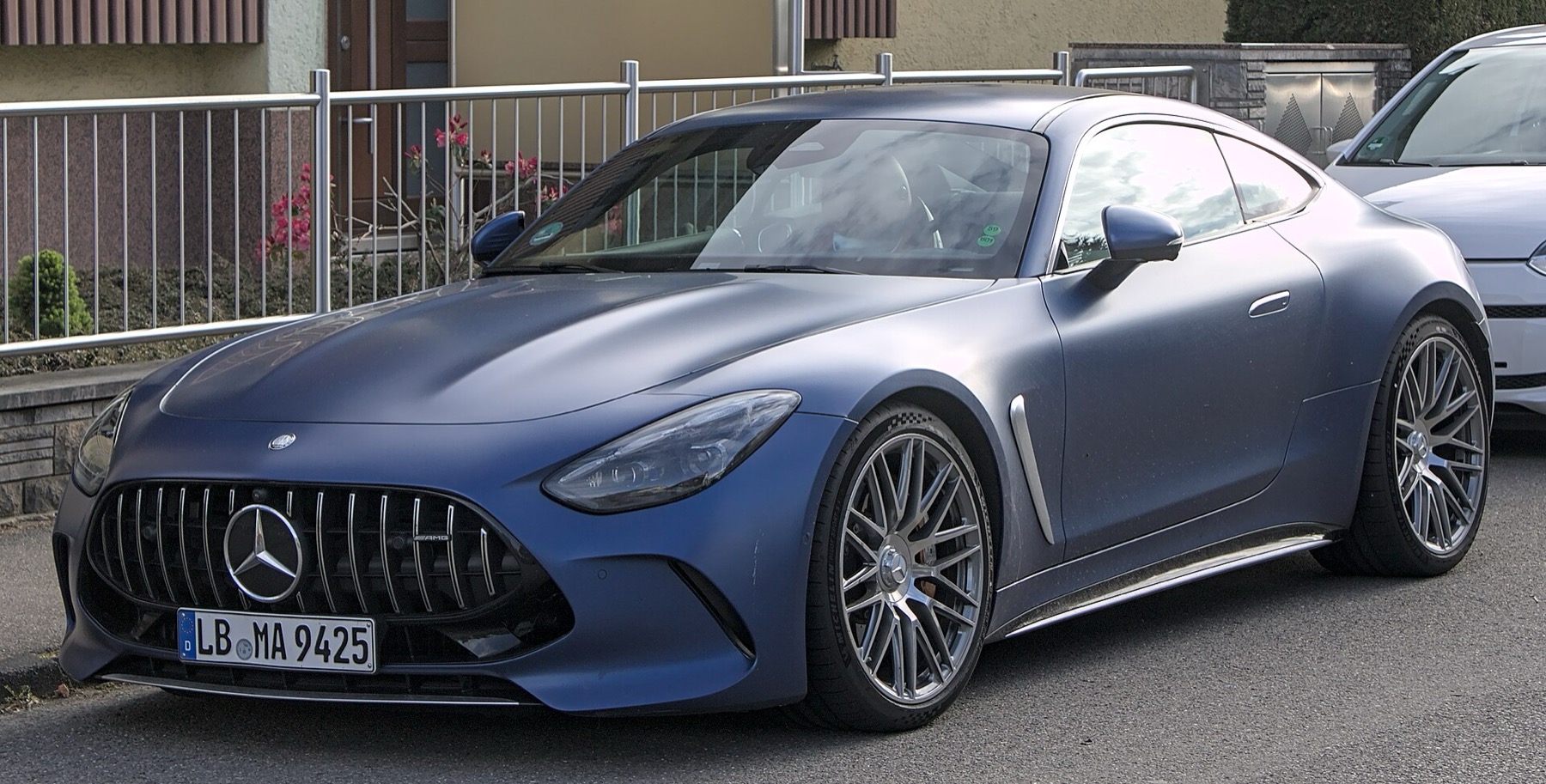
AMG GT (C192)
The second-generation AMG GT — 2+2 sports coupe, V8-retained.
Launched in 2023, the second-generation AMG GT moved to a 2+2 layout (from the previous strict two-seater) and added rear-wheel-steer and the option of all-wheel drive. The 4.0-liter twin-turbo V8 carries forward. Specification matters significantly on residuals: popular exterior colors and the carbon-ceramic brake option carry materially stronger resale than custom-spec examples.
AMG SL (R232)
The roadster flagship — V8-retained, replacing the previous AMG GT Roadster.
The R232 SL returned to AMG-development in 2022 after a hiatus in the Mercedes-Benz lineup. SL 55 and SL 63 trims share the 4.0-liter twin-turbo V8 architecture with the AMG GT and GLE 63. The 2+2 cabin returns after a generation of strict two-seat layout. The SL competes directly against the Aston Martin DB12 Volante and the convertible Bentley Continental GT.
AMG GT 4-Door Coupe (X290)
The four-door sedan-coupe in the GT family.
The AMG GT 4-Door covers the segment between an AMG sedan and an AMG sports car. Built on the AMG-specific MRA-derived platform rather than the E-Class chassis, it is engineered as a GT first and a sedan second. The 53 and 63 trims continue with the V8 and inline-six hybrid powertrains respectively. The 4-Door competes directly against the Porsche Panamera Turbo and the Audi RS7.
C 63 / E 63 (current generation)
The performance sedans — now powered by a high-output four-cylinder hybrid.
The W206 C 63 S E Performance and W214 E 63 S E Performance share the M139l 2.0-liter four-cylinder turbocharged engine paired with an electric rear axle, replacing the previous twin-turbo V8. Peak power exceeds the outgoing V8 on paper. The transition has been controversial with the existing C 63 / E 63 buyer base; resale behavior on the new platform has not yet stabilized as of 2026. Pre-transition V8 examples trade on different logic.
GLE 63 / GLS 63 / GLC 63
AMG-developed performance SUVs across three sizes.
The GLE 63 S (W167) and GLS 63 (X167) retain the 4.0-liter twin-turbo V8 architecture. The GLC 63 (X254) moved to the four-cylinder hybrid powertrain in the latest generation. All three carry AMG-specific suspension, brakes, and interior trim, and all three are assembled at Mercedes-Benz US facilities in Tuscaloosa, Alabama, with AMG engine work at Affalterbach.
AMG ONE
The F1-derived hypercar — 275 units, allocation closed.
The AMG ONE is engineered around a derivative of the Mercedes-AMG Petronas F1 1.6-liter V6 turbo-hybrid power unit, road-adapted with four electric motors for combined output exceeding 1,000 horsepower. Production was capped at 275 units at approximately $2.7 million each. Allocation closed in 2017; the AMG ONE now trades exclusively on the collector secondary market.
Mercedes-AMG press gallery
AMG GT (C192) — the second-generation 2+2 sports coupe; a GT 63 S E Performance pictured.Photo: Alexander-93, CC BY-SA 4.0 · Source · CC BY-SA 4.0 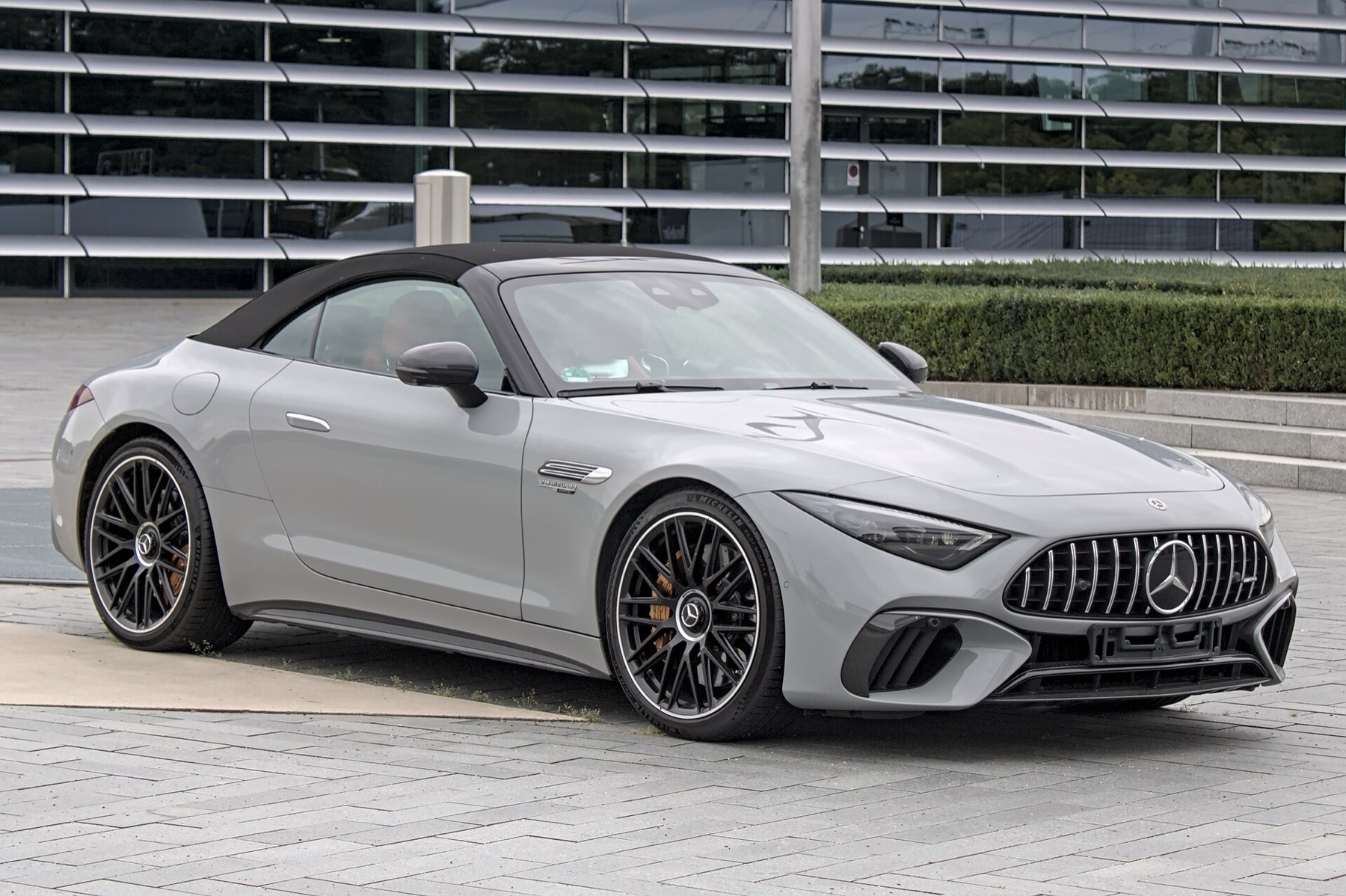
AMG SL 63 (R232) — the roadster flagship, back under AMG development since 2022.Photo: Alexander-93, CC BY-SA 4.0 · Source · CC BY-SA 4.0
Ownership reality
Mercedes-AMG ownership carries the depreciation pattern typical of the German performance segment with one significant exception. The C 63, E 63, AMG GT 4-Door, GLE 63, GLS 63, GLC 63, and SL absorb 30 to 45 percent in the first three years, then flatten through years four to six before specification and provenance start driving variability. The AMG GT (C192) is too new to characterize confidently as of 2026; the previous generation followed the same overall pattern. The G 63 is the exception — US allocation backlog supports above-MSRP secondary-market pricing for the first one to three years on most configurations.
Service is structured around two intervals: A-service annual or 10,000-mile, B-service every two years or 20,000 miles. Annual A-service at an AMG Performance Center runs $400 to $900; biennial B-service runs $1,500 to $3,500 depending on model and consumables. Tire cost is the meaningful line item on the V8 cars, which wear large-diameter Michelin Pilot Sport 4S or 5 sets. The V8 cars also carry higher fuel cost than the hybrid sedans; the G 63 is the highest-consumption AMG by some margin.
A 2026 ValuePenguin survey puts full coverage at $433 a month on a C 63, $459 on a G 63 and $568 on an AMG GT S — roughly $5,200 to $6,800 a year — for a 30-year-old with a clean record. The AMG GT, AMG SL and G 63 sit in a higher bracket than the survey covers. The AMG ONE sits outside the standard insurance market and requires specialty collector coverage.
Warranty coverage is the Mercedes-Benz standard four-year / 50,000-mile new-vehicle warranty, with the AMG-specific 24-month / unlimited-mile certified pre-owned program available on cars meeting the program age and mileage thresholds. Pre-owned AMG cars outside warranty should be inspected at an AMG Performance Center before purchase; the V8 cars in particular have known maintenance items that an inspection will surface.
Dealer landscape
Mercedes-AMG is sold through the standard Mercedes-Benz US dealer network — an estimated 360 authorized dealers. The relevant designation for AMG buyers is the AMG Performance Center subset, currently around 75 dealers. Performance Centers carry AMG-specific tooling, factory-trained AMG technicians, and access to AMG factory specialists for the more involved V8 and AMG ONE service work. For routine A-service and B-service work, any Mercedes-Benz dealer is qualified; for major engine service, suspension rebuilds, or warranty work on the V8 cars, the Performance Center designation matters.
Independent specialists are uncommon at the AMG service level. The combination of complex factory diagnostic systems, AMG-specific tooling, and the relatively young fleet age means most owners use authorized dealers through the warranty period and continue with Performance Center service afterward. The G 63 specialist market is the exception — several US specialists focus exclusively on the G-Class platform and offer competitive service pricing on out-of-warranty cars.
Buying advice
For new-vehicle buyers, AMG allocation is mostly relaxed outside the G 63 and the discontinued AMG ONE. The C 63, E 63, AMG GT 4-Door, GLE 63, GLS 63, GLC 63, AMG GT, and SL are typically orderable with reasonable lead times at the AMG Performance Center dealer level. The G 63 is allocation-only — a productive conversation starts with the local Mercedes-Benz dealer and is mediated by existing-customer status and willingness to commit on factory build slots. Above-MSRP transactions for new G 63 examples remain common in the secondary market.
For CPO buyers, the Mercedes-Benz CPO program covers AMG cars up to a defined age and mileage threshold with a 24-month / unlimited-mile warranty extension on top of the factory new-vehicle warranty remainder. CPO AMG pricing sits meaningfully above private-party pre-owned but carries the warranty backing and a manufacturer-mandated reconditioning standard. For a buyer planning four-plus years of ownership on an AMG V8 model, the CPO math typically favors the warranty coverage.
For pre-owned buyers, the editorial sweet spot on the AMG sedans is three to four years old in the previous V8 era — depreciation has absorbed, options are typically loaded, and the platform is mechanically mature. The W213 E 63 S (final V8 E 63) and W205 C 63 S (final V8 C 63) are now defined by their place in the V8-to-hybrid transition; condition and provenance matter more than they did pre-transition. For the GLE 63 S and GLS 63, similar logic applies but inspect service history carefully — these cars are used as primary family vehicles and show it.
For collector-grade interest, the AMG ONE is the obvious flagship piece but trades exclusively at private-treaty levels above the original $2.7 million MSRP. Among accessible collector pieces, the C 63 Black Series (2008 W204, 2012 W204 Coupe Edition 507) and the SLS AMG Black Series (2013-2014) are the references — limited production, defined Black Series engineering work, and clear collector trajectories. The 190E 2.5-16 Evolution II from the late Cosworth era is the deep heritage piece.
Frequently asked questions
What does AMG stand for?
AMG stands for Aufrecht, Melcher, Großaspach — the surnames of founders Hans Werner Aufrecht and Erhard Melcher, combined with Großaspach, Aufrecht's birthplace. The operation was founded in 1967 as an independent racing-engine specialist and Mercedes-Benz tuner.
Is Mercedes-AMG owned by Mercedes-Benz?
Yes. Mercedes-Benz acquired a 51 percent stake in AMG in 1999 and the remaining 49 percent in 2005. Mercedes-AMG GmbH has operated as a wholly-owned subsidiary of Mercedes-Benz Group AG since. The Affalterbach operation retains independent model engineering, engine assembly, and racing-program authority within the larger group.
What is the "One man, one engine" plaque?
A signed plaque attached to each AMG handbuilt engine, identifying the specific Affalterbach technician who assembled it from start to finish. The practice formalizes the handbuilt-assembly philosophy that distinguishes AMG engine work from the conveyor-built powertrains in standard Mercedes-Benz models. The plaque carries the technician's signature and is visible on the engine cover.
Why did Mercedes-AMG replace the C 63 and E 63 V8s with a four-cylinder?
The W206 C 63 S E Performance and W214 E 63 S E Performance moved to a 2.0-liter four-cylinder turbocharged engine paired with an electric rear axle, with combined output exceeding the outgoing twin-turbo V8s on paper. The transition was driven by emissions regulations and the broader Mercedes-Benz Group powertrain electrification roadmap. Buyer reaction has been mixed; resale behavior on the new platform is still stabilizing as of 2026. The V8 architecture is retained on GLE 63, GLS 63, G 63, AMG GT, and AMG SL.
Why does the G 63 hold its value so well?
US allocation backlog is the main driver. New G 63 orders frequently take 18 to 36 months for delivery at the dealer level, and the secondary market clears at above-MSRP for the first one to three years on most configurations. The G-Class platform is also mechanically continuous across decades — the W463A architecture is a refinement of the original 1979 design — which removes the generation-transition risk that drives faster depreciation on most other AMG models.
What is an AMG Performance Center?
A designated subset of Mercedes-Benz US dealers — approximately 75 of the 360 in the network — that carry AMG-specific tooling, factory-trained AMG technicians, and access to AMG factory specialists for the more involved service work. The designation is most relevant for buyers of the V8 cars and the AMG ONE; for the four-cylinder hybrid models and routine A-service / B-service, any Mercedes-Benz dealer is qualified.
How does Mercedes-AMG compare to BMW M and Audi Sport?
All three are the in-house performance divisions of their respective German marques. AMG's differentiating practice is handbuilt engine assembly at Affalterbach and the historical V8 emphasis (now in transition). BMW M operates from Garching with a more racing-engineering-led brief and a tradition of straight-six and V8 engines. Audi Sport (formerly quattro GmbH) shares engineering with Porsche on some platforms and runs heavier into all-wheel-drive specification. The three divisions compete most directly in the executive-sedan segment (C 63 / M3 / RS5) and the performance-SUV segment (GLE 63 / X5 M / RS Q8).
Figures on this page carry their source. Positioning, allocation practice, and where this marque sits against its rivals are editorial judgment by The Marque Editors — informed by that data, but readings of it rather than measurements. How both are produced: methodology.