The Best Year to Buy a Used Ferrari SF90 Stradale: Early Cars, the Assetto Fiorano Premium and Where Values Settle After the 849 Testarossa
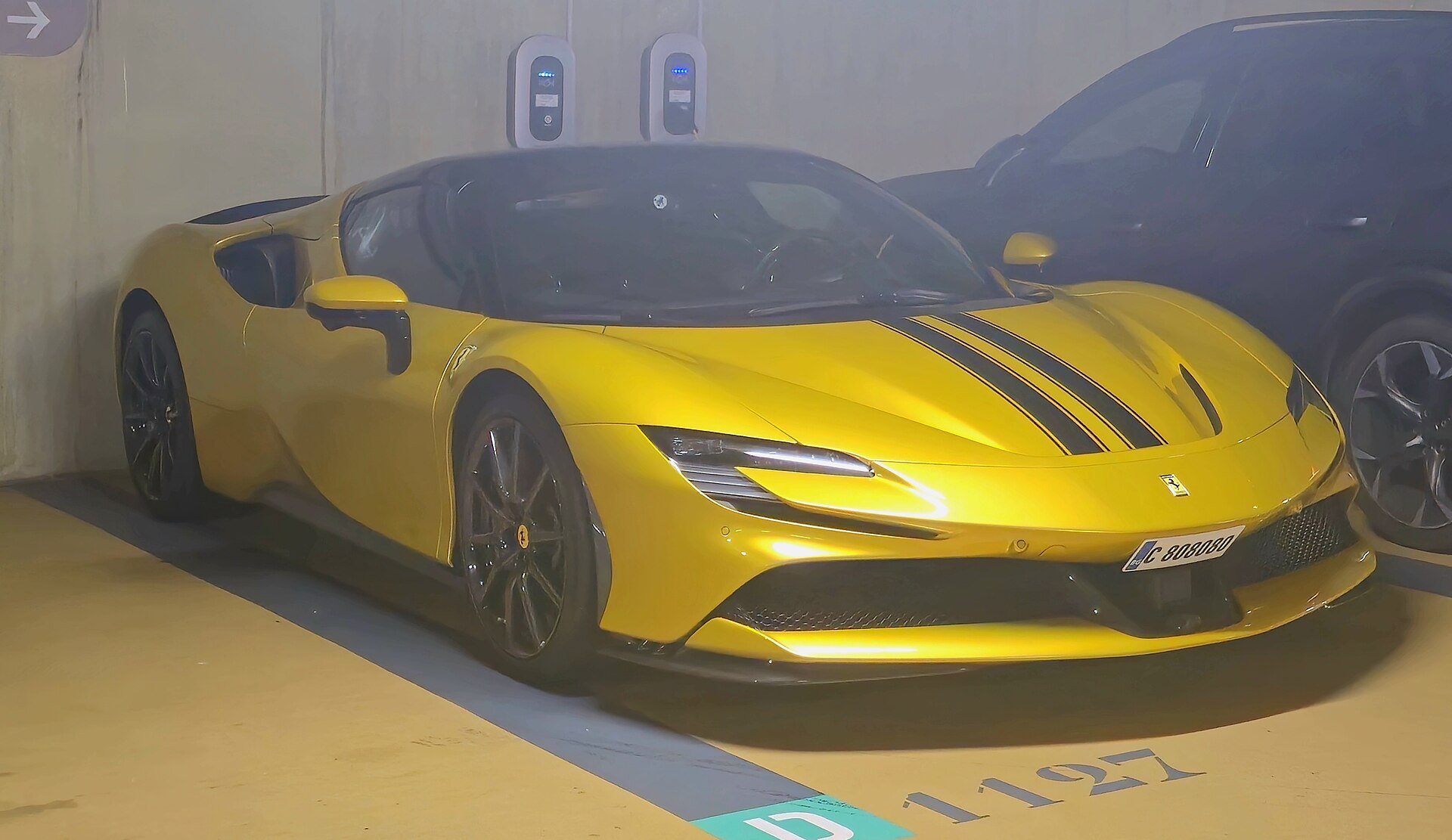
For most of its history, Ferrari has defined the flagship by its engine, and for decades that meant twelve cylinders mounted up front. The SF90 Stradale rewrote that brief in 2019, pairing a twin-turbocharged V8 with three electric motors and making the most powerful series-production road car Ferrari had built at the time a plug-in hybrid.
That said, the question for a US buyer in late 2026 is no longer whether the hybrid flagship works. With five model years on the used market and the 849 Testarossa now taking over the role, the real questions are which SF90 to buy, what the Assetto Fiorano specification is worth, and where values are likely to settle.
What The SF90 Stradale Asks Of A Used Buyer
The SF90 combines a 4.0-liter twin-turbocharged V8 with two electric motors on the front axle and a third between the engine and the eight-speed dual-clutch gearbox. Ferrari quotes 1,000 CV combined, roughly 986 hp, and up to 25 km — about 15.5 miles — of front-drive electric running in eDrive mode from a 7.9 kWh battery.
As a result, the car asks more of a second owner than a 458 Italia or an 812 Superfast does. Keep in mind that you are buying a high-voltage battery, a substantial software layer, and a brake-by-wire system alongside the engine, and each carries its own inspection and coverage logic.
What's more, the coupe launched at a reported US MSRP of roughly $507,000, according to Ferrari North America pricing published at launch by Car and Driver. Our luxury car MSRP reference explains why that base figure rarely matches a delivered car, since most SF90s left Maranello with substantial option content.
US Model Years At A Glance
Ferrari began US deliveries of the coupe for the 2021 model year, and the SF90 Spider, with its retractable hardtop, followed for 2022. The limited-series SF90 XX Stradale and XX Spider sit above both and trade on collector logic, so this playbook focuses on the series-production cars.
The table below organizes the years by what matters most to a second owner in late 2026 — how much factory maintenance remains and how settled the car is.
| Model year | Body styles | Genuine Maintenance remaining (estimated, late 2026) | Editorial view | |---|---|---|---| | 2021 | Coupe | About 1–2 years | Launch-year car; price the coverage gap | | 2022 | Coupe, Spider | About 2–3 years | Sweet spot for value and coverage | | 2023 | Coupe, Spider | About 3–4 years | Sweet spot; widest choice of specification | | 2024 | Coupe, Spider | About 4–5 years | Smaller discount to a new car | | 2025 | Coupe, Spider | About 5–6 years | Late run; buy on spec, not on year |
Maintenance windows are estimated from the original registration date, which can trail the model year by several months, so confirm each car's start date with a Ferrari dealer. In addition, later cars may surface as final allocations clear, but too few have reached the used market to read with confidence.
Should You Buy A Launch-Year 2021 Car?
Launch-year Ferraris tend to accumulate the most software updates and service campaigns over their lives, and the SF90 depends on software for everything from torque split to braking. Before committing to any early example, run the VIN through the NHTSA recall lookup and ask the selling dealer for a printout of completed campaigns.
The second early-car issue is coverage. Ferrari's 7-year Genuine Maintenance program runs from first registration rather than from the date you buy the car, so a coupe registered in early 2021 has little scheduled service left on Ferrari's account.
Of course, the case for an early car is price. If the asking figure reflects both the coverage gap and the cost of the next major service — see our breakdown of Ferrari service costs by model — a well-documented 2021 car can still be a rational entry point to the series.
Why 2022 And 2023 Are The Sweet Spot
The 2022 and 2023 cars sit a year or more removed from launch, offer both body styles, and still carry meaningful Genuine Maintenance coverage into the late 2020s. Furthermore, their original owners paid full flagship pricing before the 849 Testarossa was revealed, which makes them the sellers most exposed to the successor's arrival.
This is why we expect the widest choice of specification in these two years. Remember that a sweet spot is a band rather than a single year: a 2023 car with the right options and complete records is worth more to a second owner than a 2024 car with neither.
The 2024 and 2025 cars carry the longest remaining coverage, yet they also carry the smallest discount to a new car. For most buyers, those years make sense only when the specification is exactly right and a comparable earlier car cannot be found.
The Assetto Fiorano Premium
The Assetto Fiorano specification was a factory package rather than a separate model, and it was ordered at the time of build. Accordingly, verify it on the original window sticker or build sheet rather than by visual cues, since carbon wheels and a two-tone wrap can be added to a standard car.
On the road, the passive Multimatic dampers ride more firmly than the standard car's adaptive setup, and the lighter door panels change the cabin's feel. For a buyer who will put most of the car's miles on public roads, that trade-off deserves a back-to-back test drive before it earns a premium.
Keep in mind that the size of the premium moves with the market and with the individual car, so we do not publish a single figure. Compare asking prices for Assetto Fiorano and standard cars of the same model year and mileage band on Hagerty, Edmunds, and Ferrari Approved listings, and treat any spread you find as an estimate rather than a rule.
Specification That Moves Residuals
Beyond the Assetto Fiorano package, a handful of options shape how an SF90 is priced and how quickly it sells. The specification points to check include but are not limited to:
- Front suspension lift. A nose-lift system is close to essential for US driveways and parking structures. Cars without it can be harder to resell.
- Carbon-fiber exterior and wheels. Carbon packages added significant cost when new and remain desirable. They typically recover only part of their original price.
- Tailor Made and paint-to-sample. A considered Tailor Made specification can lift interest, while an unusual one narrows the buyer pool. Taste is the one variable no market guide can price.
- Seating and interior options. Sport seating, upgraded audio, and passenger display options matter less than the items above. They do help a car stand out in a thin market.
- Documentation. The original window sticker, complete Ferrari dealer service records, and both keys belong with the car. Missing paperwork costs more on a hybrid, because battery and software history live in those records.
All of these add up to a simple rule. Buy the specification first and the model year second.
Where Values Settle After The 849 Testarossa
Ferrari revealed the 849 Testarossa in September 2025 as the SF90's successor, with more power from a revised hybrid V8 drivetrain. As customer deliveries ramp, owners who want the newest flagship will trade out of their SF90s, adding supply to the used market.
The pattern has precedent. The 458 Italia softened after the 488 arrived, as covered in our used Ferrari 458 buying guide, and the used Ferrari 812 market has been adjusting to the 12Cilindri along similar lines.
That said, the SF90 carries one variable those cars did not: battery age. Buyers later this decade will price an early car's original high-voltage pack against its remaining coverage, so the floor for 2021 cars may sit lower and arrive later than for the 2023 to 2025 cars.
Overall, we expect the curve to flatten once successor deliveries reach a steady pace and the flow of trade-ins normalizes. Production estimates for each SF90 model year vary and Ferrari does not publish them by market, so verify current comps against authoritative sources before any transaction.
Pre-Purchase Inspection For A Hybrid Ferrari
A pre-purchase inspection (PPI) on an SF90 should be performed by a Ferrari dealer or a specialist with the factory diagnostic equipment needed to read the hybrid system. Here's a list of what that inspection should cover:
- High-voltage battery health. Request a written state-of-health report from the diagnostic session. A pack that has sat discharged for long periods deserves closer scrutiny.
- Software and campaigns. Confirm the car runs current software and that every recall and service campaign is closed. Ask for documentation rather than verbal assurance.
- Cooling and charging hardware. Inspect the charging port, the cable, and the radiators that serve both the engine and the hybrid system. Front-end damage can hide in the cooling package.
- Tires and brakes. Check tire date codes as well as tread, particularly on cars fitted with Cup 2 tires. Confirm the brake-by-wire system shows no stored faults.
- Body and title. Measure paint thickness, review paint protection film edges, and pull a vehicle history report. Carbon and aluminum repairs are costly to verify after the fact.
Moreover, ask whether the car qualifies for Ferrari Power or Power15 extended coverage, and confirm in writing which hybrid components are included. Our guide to hypercar ownership programmes explains how factory coverage compares across marques.
Financing And Total Cost Of Ownership
Many SF90s change hands with financing, and the structure of the loan matters as much as the purchase price. Our exotic car financing guide covers term lengths, balloon structures, and how lenders approach collateral in this segment.
Remember that the purchase price is only the first line of the budget. Insurance, tires, the next major service, and any extended coverage all belong in the number before you make an offer.
Editorial Recommendation
For a US buyer researching an SF90 in late 2026, our recommendation reads as follows:
- Best overall. A 2022 or 2023 SF90 Stradale coupe with the front lift, complete Ferrari dealer records, and at least two years of Genuine Maintenance remaining.
- Best for open-air driving. A 2023 SF90 Spider meeting the same criteria, compared only against Spiders of matching mileage and specification.
- Best for track use. An Assetto Fiorano coupe with a documented original build sheet, bought on condition rather than on livery.
- Best value. A 2021 coupe priced to reflect its coverage gap, with every campaign closed and a fresh battery state-of-health report.
- Patience play. Let 849 Testarossa deliveries add supply, then buy into the flattening curve rather than its first step down.
Cross-Shopping The SF90
If the SF90 is one of several cars on your list, our best-year guide to the McLaren 720S and our Ferrari Purosangue buying guide apply the same model-year logic to two very different alternatives. Whichever you choose, the right SF90 is the one with the paperwork to prove its history — and a price that already accounts for the 849 Testarossa.
Frequently asked questions
How far can a Ferrari SF90 Stradale drive on electric power alone?
Ferrari quotes up to 25 km, roughly 15.5 miles, in eDrive mode, using only the front-axle motors and the 7.9 kWh battery at up to 135 km/h. Real-world range falls with cold weather and an aging battery.
Does Ferrari Genuine Maintenance transfer to a second SF90 owner?
Yes. Genuine Maintenance covers scheduled service for seven years from the original registration date regardless of ownership, so a 2021 car bought in late 2026 has little left. Confirm the start date with a Ferrari dealer.
Can a used SF90 Stradale be covered by Ferrari Power15?
Power15 can extend powertrain coverage up to a Ferrari's fifteenth year, subject to a dealer inspection and continuous enrollment. Ask the selling dealer about eligibility and which hybrid components are included before you sign.
How should a buyer compare a used SF90 Spider with the coupe?
The Spider arrived for the 2022 US model year with a retractable hardtop and a higher original MSRP. Compare Spiders only against Spiders of matching mileage and specification, since body style moves asking prices.
Is the SF90 XX Stradale part of the same used market as the SF90?
No. The XX Stradale is a limited series of 799 coupes, with 599 XX Spiders, built for track use and sold to selected clients. It trades on collector logic rather than the series-production depreciation curve.