What the MSRP Actually Includes on a Luxury Car: Destination, the Gas-Guzzler Tax, Options and How to Tell If a Figure Is Current
Few
purchases at this level come with as much published pricing as a new luxury car, from the manufacturer's configurator and press releases to the window sticker that federal law requires on every new vehicle. That said, the figure most buyers call "the MSRP" often blends several separate lines, and each one comes from a different source and follows different rules.This matters most when you are comparing a quote against a published figure or against a car on another dealer's floor. Below, we set out what the manufacturer's suggested retail price covers, what sits beside it on the label, and how to confirm that a figure is current before you rely on it.
Where An MSRP Figure Comes From
Every MSRP starts with the manufacturer's price sheet, the internal schedule that sets a suggested retail price for each model, trim and factory option in a given model year. Buyers see that schedule through three public channels: the manufacturer's online configurator, its newsroom pricing announcements, and the window sticker on the car itself.
The window sticker is known as the Monroney label, after the senator who sponsored the Automobile Information Disclosure Act of 1958. Under that statute, the label must stay on a new car until it is delivered to the retail buyer, and removing or altering it before then is a federal offense.
Of the three, the Monroney label is the most reliable record for a specific car, because it shows the prices that applied when that car was built. Configurators and press releases show the prices currently in force for new orders, which may differ.
What The Monroney Label Lists
The 1958 Act, together with later EPA and NHTSA rules, sets out what must appear on the sticker. For a new luxury car, the lines that bear on price include but are not limited to:
- Base price. The manufacturer's suggested retail price for the model and trim, before any options are added.
- Factory-installed options. Each option or package installed at the factory, with its individual suggested price.
- Transportation charges. The cost of delivering the car to the dealer, usually labeled destination or delivery.
- Gas-guzzler tax. Where it applies, the federal excise tax is shown on the label, alongside the EPA fuel economy and environment information.
- Total suggested price. The sum of the lines above, which is the most complete manufacturer figure for that car.
All of these lines come from the manufacturer, not the dealer. Anything the dealer adds (accessories, protection packages, market adjustments) belongs on a separate addendum sticker, which is where the real transaction price starts to move away from MSRP.
The Destination Charge
The destination charge covers shipping the car from the factory or port of entry to the selling dealer. Manufacturers name it differently; Porsche, for instance, lists a Delivery, Processing and Handling Fee on its US pricing.
Most manufacturers set one national destination figure for a given model, so a buyer in Miami and a buyer in Seattle typically pay the same charge. Keep in mind that it is billed to the dealer and passed through on every car, which is why it is rarely negotiable in practice.
This is the most common reason two published figures for the same car disagree. A newsroom release may quote a starting price "plus destination," while a review site or a dealer listing quotes the total; neither is wrong, but they are not measuring the same thing.
The Federal Gas-Guzzler Tax
The gas-guzzler tax was created by the Energy Tax Act of 1978 and is codified at 26 U.S.C. 4064. It is an excise tax paid by the manufacturer or importer on the first sale of a new passenger car whose fuel economy falls below 22.5 mpg, and the cost is reflected on the Monroney label.
The schedule has not changed since 1991. Per the statute and the IRS instructions for Form 720, the tax for a passenger car with a combined fuel economy of:
- At least 22.5 mpg is $0
- 21.5 to 22.5 mpg is $1,000
- 20.5 to 21.5 mpg is $1,300
- 19.5 to 20.5 mpg is $1,700
- 18.5 to 19.5 mpg is $2,100
- 17.5 to 18.5 mpg is $2,600
- 16.5 to 17.5 mpg is $3,000
- 15.5 to 16.5 mpg is $3,700
- 14.5 to 15.5 mpg is $4,500
- 13.5 to 14.5 mpg is $5,400
- 12.5 to 13.5 mpg is $6,400
- Under 12.5 mpg is $7,700
One detail catches even experienced buyers. The tax is assessed on the EPA's unadjusted laboratory figures, weighted 55% city and 45% highway, rather than on the lower adjusted numbers printed on the fuel economy label; as a result, a car whose sticker reads below 22 mpg combined may land in a lower tax tier, or owe nothing at all.
The tax applies to passenger cars only. Light trucks, a category that typically includes SUVs, are exempt, which is one reason the super-SUVs in our Bentayga, Cullinan, Urus and Purosangue comparison usually carry no guzzler line; confirm the classification on the car's label or its EPA record at fueleconomy.gov.
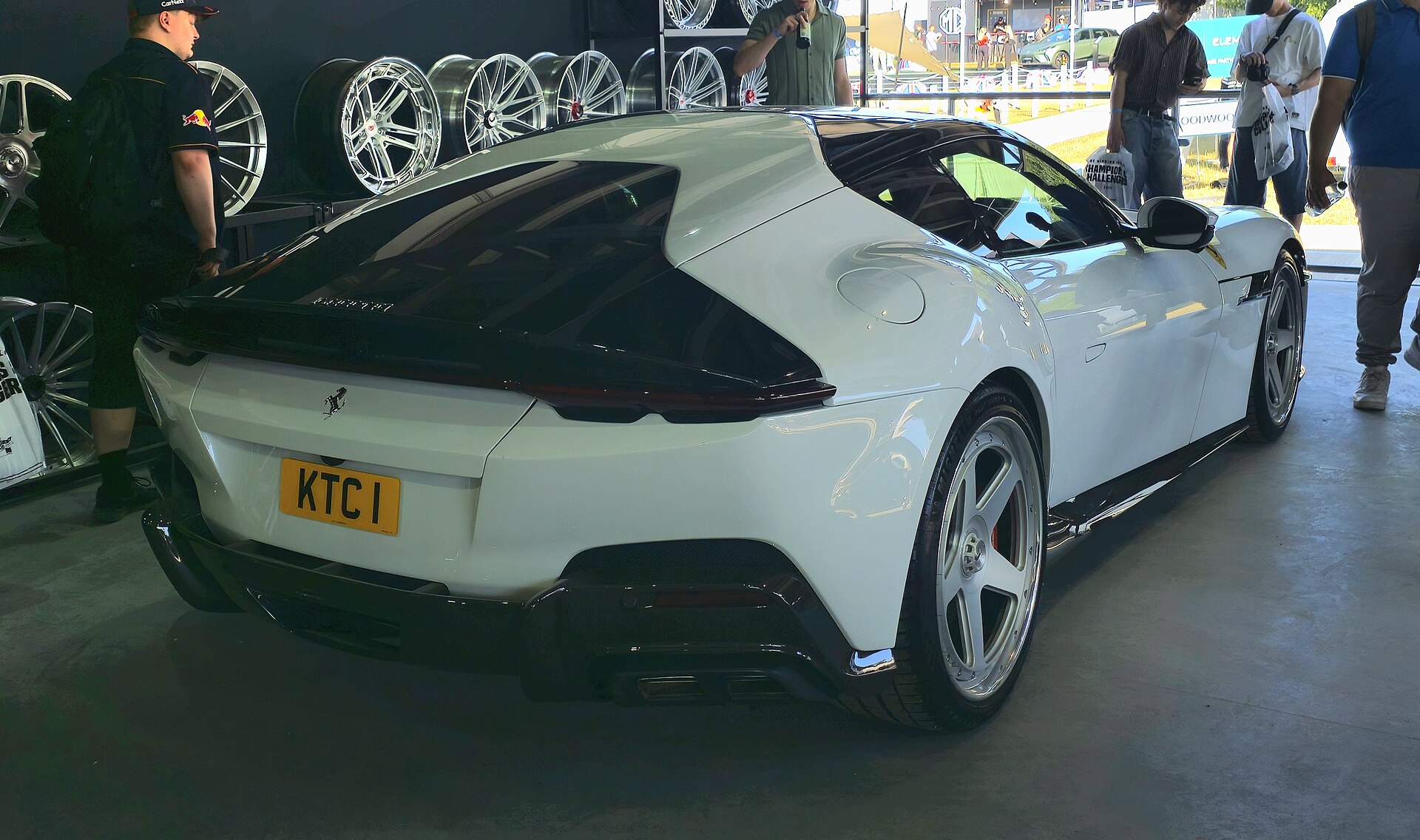
Fully electric cars are exempt as well. The line therefore appears most often on large-displacement grand-tourers and berlinettas, such as a naturally-aspirated V12 like the Ferrari 12Cilindri, where it is worth checking the label rather than assuming.
Options, Packages And Paint-To-Sample
Factory options are where the gap between two cars of the same model opens up. Each option or package installed at the factory is priced on the Monroney label, and on a well-specified exotic, the options total can add a significant share to the base price.
Bespoke programs complicate the picture. Personalization work through programs such as Porsche Exclusive Manufaktur, Ferrari Tailor Made, Rolls-Royce Bespoke and Bentley Mulliner is often quoted through the dealer rather than published in the public configurator, so the only authoritative record of that pricing is the car's own label and order documents.
Option pricing also shapes what the car is worth later. Not every option holds its value, and the specs that drive residuals are covered in our luxury depreciation leaders analysis.
What Sits Outside The MSRP
Several costs routinely appear on a luxury-car buyer's order that the manufacturer's figure does not cover. The main ones include:
- Market adjustment. Also called additional dealer markup, this is a dealer-set premium above MSRP, common on allocated cars and entirely separate from the manufacturer's price.
- Dealer-installed accessories. Films, coatings and protection packages added at the dealership appear on the addendum, not the Monroney.
- Documentation fee. A dealer processing charge whose limits vary by state.
- Sales tax, title and registration. Set by the state and local jurisdiction and calculated on the transaction price, not on MSRP.
- Financing costs. Interest and fees depend on the lender and structure, which we cover in our guide to exotic car financing.
All of these sit between the published MSRP and the amount that actually leaves your account. What's more, on allocated models the market adjustment can be the largest single variable, which is why the gap between list and transaction price is a recurring theme in our Ferrari Special Series coverage.
How To Tell If A Figure Is Current
Manufacturers adjust pricing at each model-year changeover, and some raise prices within a model year as well. A figure that was accurate when published can be outdated months later, so here is how we check one before relying on it:
- Confirm the model year. A price without a model year cannot be verified, since option prices and base prices both change at changeover.
- Check the manufacturer's configurator and newsroom. The configurator shows current pricing for new orders, and newsroom releases usually date each price announcement.
- Compare against the car's build date. The Monroney label reflects prices in force when the car was built, and the federal certification label on the door jamb shows the month and year of manufacture.
- Treat third-party figures as secondary. Edmunds, KBB and similar sources are useful cross-references, but note the date their data was last updated.
- Read the footnote. Confirm whether destination and the gas-guzzler tax are included before comparing two figures.
This sequence explains most apparent discrepancies. For instance, a car built before a mid-year price increase will carry the older MSRP on its sticker, while the configurator shows the higher figure that applies to cars ordered today.
How We Cite MSRP At Marque
Every MSRP we publish names its source and its model year, and states whether destination is included. Where a figure cannot be verified against the manufacturer, the configurator or a named third-party source, we mark it as estimated rather than present it as exact.
The same discipline applies after the sale. On a used or collector car, the original Monroney label is part of the car's provenance, alongside the books, service history and window-sticker options list, and it is worth requesting during a pre-purchase inspection.
Editorial Recommendation
Before you compare any two luxury-car prices, we suggest the following:
- Anchor on the Monroney total. It is the only manufacturer figure that includes base price, factory options, destination and any gas-guzzler tax for a specific car.
- Separate manufacturer lines from dealer lines. Keep the Monroney and the dealer addendum on separate sheets when comparing offers.
- Check the guzzler line on passenger cars. Large-displacement coupes and grand-tourers are where it appears; super-SUVs and electric cars are typically exempt.
- Date every figure. Treat any MSRP without a model year and source as unverified.
Keep in mind that the price on the sticker is where the conversation starts, not where it ends. For the costs that follow delivery, from insurance to service intervals, see our breakdown of supercar ownership costs, and for the choice between buying new and buying well-kept, our new versus used luxury analysis.