The Best Year to Buy a Used Ferrari 458 Italia: Early Cars, the Spider and Speciale Split, and Where the Last Naturally Aspirated Mid-Engine V8 Settles
F
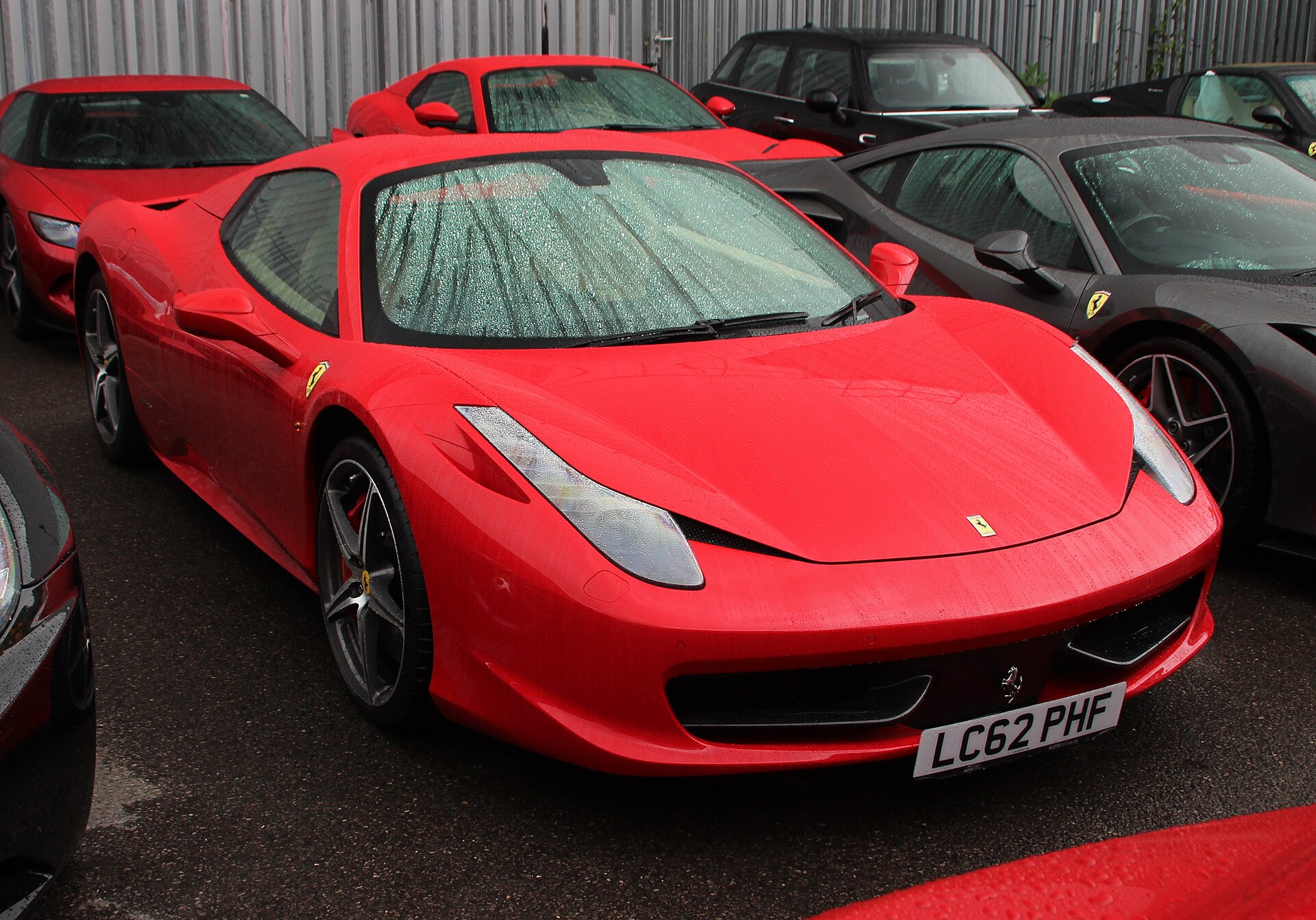
errari has built mid-engine V8 berlinettas for roughly half a century, and each generation has had to decide how much of the engine's character survives the push toward efficiency and emissions compliance. The 458 Italia, sold in the US from the 2010 through 2015 model years, is the last of that line to make the trade without turbochargers.That distinction now shapes the used market more than any single option or color. Every 458 trades partly on its 4.5-liter naturally aspirated V8 and its 9,000-rpm power peak, so the useful question for a buyer is which 458 to own — an early coupe, a later coupe, the Spider, or the Speciale.
Where the 458 Sits in Ferrari's V8 Line
The 458 replaced the F430, and Ferrari succeeded it with the twin-turbo 488 GTB for the 2016 model year, which we cover in our used Ferrari 488 buying analysis. The F8 Tributo followed, and our used Ferrari F8 guide picks up the curve from there.
Ferrari rated the 458's F136 V8 at 562 hp (570 CV) and 398 lb-ft, paired with a seven-speed dual-clutch gearbox. For a buyer, that pairing is the point: it drops the F430's single-clutch automated manual and its clutch-wear profile while keeping the atmospheric engine that the 488 gave up.
In other words, the 458 sits at a hinge in the lineage. It is modern enough to be used regularly, yet it carries the engine character that later cars traded for turbocharged torque.
The Three Body Styles and What They Cost New
The 458 family splits into three distinct markets, and each one behaves differently on the used curve. The table below sets out the essentials, including our estimated 2026 market ranges:
| Variant | US model years | Power (Ferrari rating) | Approx. base launch MSRP | Estimated 2026 market range | | --- | --- | --- | --- | --- | | 458 Italia (coupe) | 2010–2015 | 562 hp | ~$230,000 | $190,000–$260,000 (estimated) | | 458 Spider | 2012–2015 | 562 hp | ~$257,000 | $215,000–$300,000 (estimated) | | 458 Speciale | 2014–2015 | 597 hp | ~$292,000 | $450,000–$650,000 (estimated) | | 458 Speciale A | 2015 (499 units) | 597 hp | Not widely published; verify | $750,000–$1,100,000+ (estimated) |
Launch MSRPs are approximate base prices before options and destination, as reported at each car's introduction; most cars left the factory with substantial option content. Market ranges are Marque editorial estimates drawn from dealer and auction listings, not appraisals — verify any specific car against Hagerty Valuation Tools and recent completed sales before transacting.
The Depreciation Curve: Why the 458 Stopped Falling
Like most V8 Ferraris, the 458 shed value quickly in its first years on the road, as broader Ferrari depreciation sweet-spot patterns would predict. That said, the arrival of the turbocharged 488 changed the 458's position from outgoing model to last-of-type, and the market began pricing it accordingly.
Values rose with the wider collector-car market in 2021 and 2022 and have broadly softened since, according to Hagerty's market commentary. Keep in mind that the softening has been modest compared with the early-ownership decline, which is consistent with a car that has found its depreciation floor.
As a result, the buyer's risk has shifted. The question is no longer how much value a 458 will lose, but how much an individual car's history, spec, and warranty position will cost or protect.
Early Cars: The 2010 and 2011 Question
The earliest 458s carry two considerations that later cars do not. Neither one disqualifies a car, but both belong in the price.
First, in 2010 Ferrari recalled early 458 Italias after fires were traced to an adhesive in the rear wheel-arch heat shield area that could overheat. The remedy was performed under recall, and an NHTSA VIN lookup will confirm completion on any specific car.
Second, and more consequential today, is warranty eligibility. Ferrari's Power15 extended-warranty program, introduced in 2019, covers cars up to 15 years from first registration, subject to inspection — so the window has closed or is closing for 2010 and 2011 cars.
Note that Ferrari has revised the program's terms over time, so verify current eligibility with an authorized dealer rather than relying on a seller's summary. A late-production 2015 car, by contrast, can carry several years of potential coverage runway, and that difference has real value on a car with a dual-clutch gearbox and complex electronics.
There are also age-related cabin issues common to Ferraris of this era. Soft-touch coatings on switches can turn tacky, and dashboard leather can shrink or lift in hot climates — neither is mechanical, but both are costly to correct properly.
The Spider: Paying for the Folding Hardtop
The 458 Spider arrived for the 2012 model year with a retractable aluminum hardtop, replacing the fabric roof of the F430 Spider. Ferrari positioned it as a usable open car rather than a weekend-only convertible, and the market has treated it that way.
The Spider launched at roughly $27,000 above the coupe, and our estimated ranges suggest that premium has broadly held on the used market. This is especially true in warm-weather metros, where our Ferrari Los Angeles buying notes show open cars moving with less time-on-market.
Of course, the roof is also a mechanism to inspect. A Spider with documented roof service and no history of water ingress deserves its premium; one without that paperwork deserves a discount.
The Speciale and Speciale A: A Different Market
The 458 Speciale, delivered in the US for the 2014 and 2015 model years, raised output to 597 hp, reduced weight, added active aerodynamics, and introduced Ferrari's Side Slip Control system. It belongs with the cars in our Ferrari Special Series analysis rather than with the regular-production 458s.
The open Speciale A followed as a 499-unit limited series, per Ferrari's announcement. Ferrari did not publish a production total for the fixed-roof Speciale; estimates vary, so verify any figure against authoritative sources before relying on it in a transaction.
Accordingly, the Speciale buying playbook looks more like a collector purchase than a used-car purchase. Mileage profile, single ownership, books and tools, and original paint carry more weight here, and buyers comparing it with other driver-focused cars may find our track-focused supercars overview a useful frame.
Specification and Options That Move Residuals
On regular-production 458s, spec matters as much as model year. The factors that tend to separate a strong car from an ordinary one include but are not limited to:
- Carbon-fiber racing seats. Buyers who intend to drive the car with intent tend to seek them out, while comfort-oriented buyers may prefer the standard seats — know which buyer you will eventually sell to.
- Suspension lifter. A front-axle lift is close to a practical requirement in cities with steep driveways and speed bumps, and cars without it can sit longer on the market.
- Carbon driver zone and LED steering wheel. These were costly options new and remain sought after, though their residual premium varies by listing and should not be assumed.
- Color and interior. Rosso Corsa is plentiful; well-chosen historical colors or paint-to-sample (PTS) cars with tasteful interiors can command a premium, but only when documented on the build sheet.
- Service history. Annual dealer or specialist service records, ideally with fluid changes and diagnostic printouts, matter more than any single option.
All of these factors add up to a simple rule. Two 458s of the same year can be tens of thousands of dollars apart on spec and paperwork alone, so compare cars on the build sheet and service file rather than the model year on the title.
What a Pre-Purchase Inspection Should Cover
A pre-purchase inspection (PPI) on a 458 should be performed by a Ferrari dealer or an established specialist with Ferrari diagnostic equipment. Here is what we would expect it to address:
- Gearbox and clutch data. A diagnostic readout of dual-clutch condition and stored fault codes, rather than a road-test impression alone.
- Recall status. An NHTSA VIN check confirming the wheel-arch recall and any other campaigns are closed.
- Paint and body. A paint-meter survey of every panel, since repaint history affects both value and future salability.
- Cabin aging. Tacky switchgear, lifting dash leather, and seat bolster wear, each of which is costly to correct to a factory standard.
- Warranty eligibility. Written confirmation from a dealer of whether the car qualifies for Power15 or a comparable extended-coverage product.
Remember that a clean PPI does not make a car a bargain; it simply makes the price you agree to an informed one. For buyers weighing how to structure the purchase, our exotic car financing guide covers lender expectations on cars of this age.
Editorial Recommendation
The 458 rewards buyers who shop the individual car rather than the model year. With that in mind, here is how we would allocate a budget:
- Best overall value: 2013–2015 458 Italia coupe. A dealer-serviced, later-production coupe with documented recall work, a suspension lifter, and the longest remaining Power15 runway.
- Best open-air choice: 2013–2015 458 Spider. The same engine with the folding hardtop, worth its premium when roof service is documented.
- Collector allocation: 458 Speciale. Low mileage, original paint, complete books and tools, and single or limited ownership — priced on provenance, not on the curve.
- Approach with care: 2010–2011 cars. Sound purchases when priced for their age and warranty position, but not when sellers ask later-car money.
Overall, the 458 has settled into the position its engine earned it: a modern Ferrari whose value now rests on being the last of its kind. If you are still deciding between this generation and a newer car, our new versus used luxury analysis and the Ferrari marque hub are the natural next steps.