911 GT3 RS vs Huracán STO vs 765LT: The Track-Focused Tier in 2026
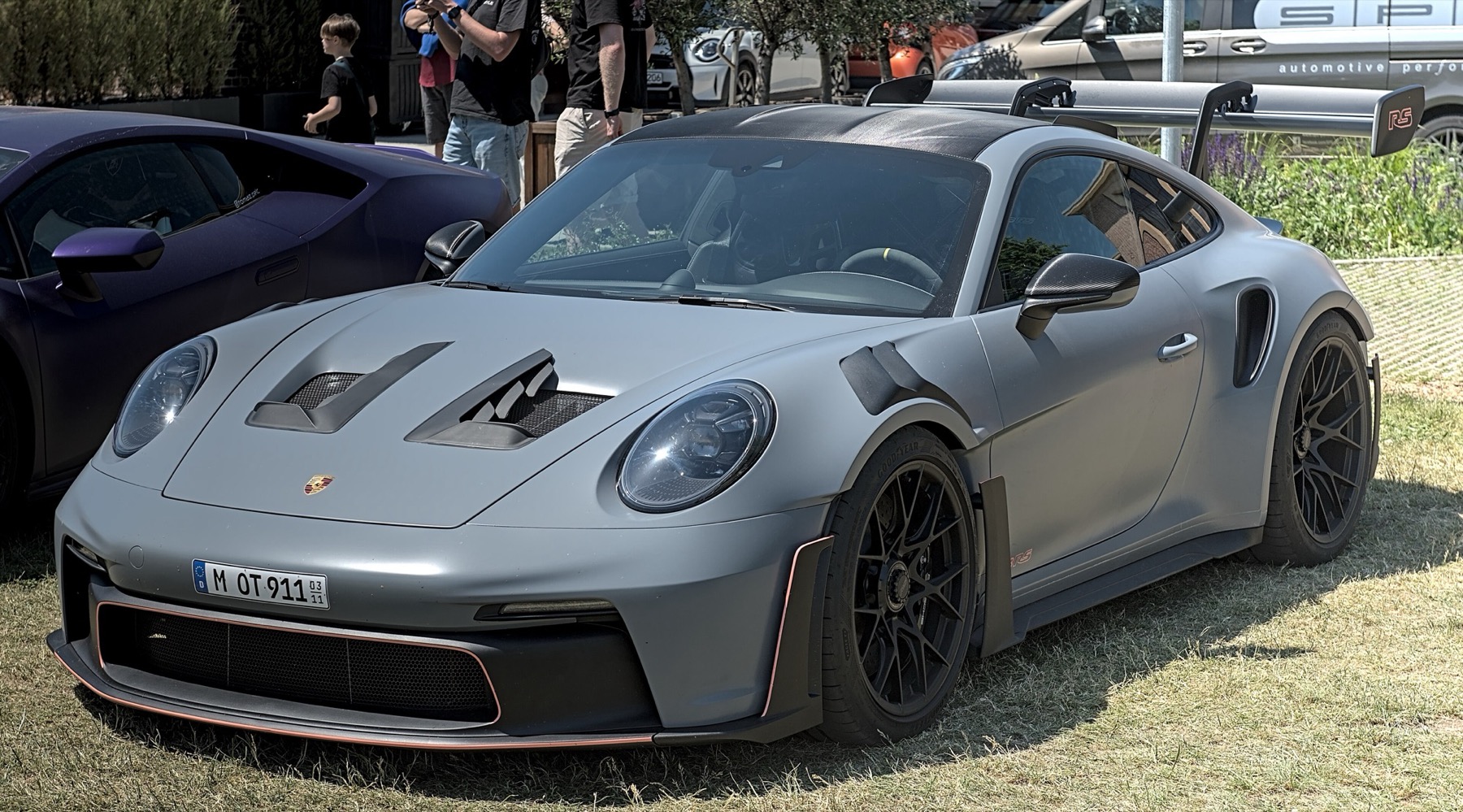
The
argument for a road-legal, circuit-biased supercar is easy to make in a showroom and considerably harder to sustain three years later. Active aero, carbon-ceramic brakes and a stripped cabin all read as value on the window sticker — what actually separates these cars shows up in tire invoices, service scheduling, and the number on a trade appraisal.Three cars define the tier for US buyers in 2026: the 992-generation Porsche 911 GT3 RS, the Lamborghini Huracán STO, and the McLaren 765LT. They were engineered against a nearly identical brief, and they ask very different things of the people who own them.
The Same Brief, Three Different Answers
Each car began as a series-production platform reworked for sustained high-load driving rather than straight-line speed alone. That shared origin explains why they cross-shop, and the engineering diverges almost immediately after it.
| Model | Engine | Output (manufacturer) | Drive | Gearbox | US launch MSRP | | --- | --- | --- | --- | --- | --- | | 911 GT3 RS (992) | 4.0L naturally aspirated flat-six | 518 hp, 9,000 rpm redline | Rear | 7-speed PDK only | About $241,300 before options and delivery, 2023 model year | | Huracán STO | 5.2L naturally aspirated V10 | 631 hp | Rear | 7-speed dual-clutch | Roughly $328,000 including destination at launch | | 765LT coupe | 4.0L twin-turbo V8 | 755 hp (765 PS) | Rear | 7-speed dual-clutch | Roughly $358,000 before options |
All of the above are manufacturer-published launch specifications given as approximations — verify current pricing and specification with the marque before you transact. Option pricing in particular moves by model year, and the Weissach Package and magnesium wheels together added an estimated $45,000 or more to a 992 GT3 RS at US launch.
Keep in mind that two of the three are finished products rather than current catalogue items. The 765LT was capped at 765 coupes and 765 Spiders worldwide, and Huracán production concluded in 2024 with the Temerario taking its place — which makes both used-market propositions in 2026 rather than allocation conversations.
Aero Philosophy: Three Bets On The Same Physics
Porsche Treats Downforce As Standard Equipment
The 992 GT3 RS moves its central radiator into the nose, frees the flanks for through-body airflow, and hangs a swan-neck rear wing above the roofline with an actively adjustable upper element. Porsche publishes roughly 900 lb of downforce at 124 mph and about 1,895 lb at 177 mph — figures that carry a real cost in drag and in how the car behaves below racing speeds.
What matters to an owner, though, is adjustability. The RS puts compression and rebound damping and the differential preload on steering-wheel rotary controls, so setup work that other cars send to a shop happens between sessions in the paddock.
Lamborghini Builds The Aero Into The Bodywork
The STO's approach is structural rather than active. The single-piece front clamshell, the roof-mounted air scoop and the manually adjustable rear wing are body architecture, and Lamborghini's published figures put the car's aerodynamic efficiency roughly 37% ahead of the Huracán Performante.
That carries a maintenance consequence buyers routinely underrate. A one-piece front section is a substantially larger and more expensive repair than a bolt-on bumper cover after ordinary track contact or a curbed splitter.
McLaren Applies Longtail Logic
McLaren's method extends the body, removes mass everywhere it can be reached, and lets the active rear wing do the balance work. The company quoted a lightest dry weight of 1,229 kg (2,709 lb) and claimed roughly 25% more downforce than the 720S, with the carbon-fiber Monocage II tub underneath carrying more of the structural load than either rival's platform.
Remember that the tub itself is durable, and that the components hung on it generate the service events. The McLaren 750S that followed shares much of that architecture, which makes it the practical reference point for what parts and specialist labor cost today.
Consumables: What A Track Day Removes From The Car
This is where the tier separates from the rest of the performance market, and where budgets are most often set wrong. All three cars leave the factory on track-compound tires and carbon-ceramic brakes, and all three consume both faster than a road-biased supercar does.
Here is what a serious track program actually spends down, and why the figures differ by marque:
- Tires. The GT3 RS ships on Michelin Pilot Sport Cup 2 R, the STO on Bridgestone Potenza Race, and the 765LT on Pirelli P Zero Trofeo R. Track compounds are consumed in heat cycles rather than miles, and a set in these staggered sizes lands in the low-to-mid four figures at US retail (estimated — price your exact fitment before you budget).
- Brakes. Carbon-ceramic rotors are standard equipment on all three, and the STO's Brembo CCM-R was specified for repeated high-energy stops in particular. Rotor replacement is a five-figure exercise on any of them when it comes due (estimated — request a written quote from a franchised dealer).
- Fluids and wear hardware. Dry-sump oil service, brake fluid flushes between events, and pad wear become recurring line items rather than annual ones once the car runs more than a few days a year. Budget these per event, not per service interval.
- Alignment and corner balance. Track alignment specifications differ from the road settings the car is delivered on, and reverting between them is labor each time. Not every franchised retailer has the scales, the specifications, or the appetite to do it.
All of this adds up to a running cost that scales with days on track rather than with odometer miles — the opposite of how most luxury-car ownership budgets are built.
Service Network Reach Is The Quiet Differentiator
Porsche's US retailer network runs to roughly 200 locations, while Lamborghini and McLaren each operate US networks numbering in the dozens — verify current counts on each marque's own dealer locator, which is the authoritative source. For an owner who tracks the car regularly, that gap decides how far a flatbed travels and how long a car waits on a part.
That said, dealer count is not the same as GT competence. Not every Porsche retailer keeps a GT-trained technician or corner-weight scales, and the informal reality is that a handful of stores in each region do the meaningful work.
Warranty coverage as published also favors Porsche on duration: four years or 50,000 miles, against three years with unlimited mileage from both Lamborghini and McLaren. Each marque runs a certified pre-owned program as well — Porsche Approved, Lamborghini Selezione and McLaren Qualified — and a CPO car with documented track use should be assessed on that history rather than on the certification alone.
How Each Has Held Value
Value retention in this tier is driven by production caps, specification and documented history rather than mileage alone. Hagerty maintains condition-graded valuations for all three, and the #2 (excellent) column is the correct anchor to establish before you read dealer asking prices.
The 911 has been the structural outlier. iSeeCars' recurring five-year depreciation studies have repeatedly placed the 911 at or near the top of the retention table across model years, and the GT cars sit above the standard range — treat any single published percentage as specific to that study edition and check the current one.
The retention logic that shapes the used 911 Turbo S market applies with more force to a capacity-constrained GT car. Accordingly, a GT3 RS bought at or near list has behaved less like a depreciating asset than anything else in this comparison.
The 765LT's cap of 765 coupes and 765 Spiders has supported values, though limited-production McLarens have historically been more volatile than limited-production Porsches. The STO sits between them: a naturally aspirated V10 in an era that has moved to forced induction and hybridization is a durable argument, but it was built in less constrained numbers, and the broader used Huracán market sets the floor it trades against.
Keep in mind that a track-focused car with documented event use is not automatically penalized. Buyers at this level read service records and heat-cycle history as evidence of maintenance rather than as damage, provided the paperwork is complete and a pre-purchase inspection supports it.
Insurance And Track-Day Cover
Most agreed-value collector policies exclude on-track operation outright, and timed or competitive events are excluded almost universally. Event-specific HPDE cover is written separately and priced against insured value per event day — obtain a quote in writing rather than assuming an existing policy carries over.
Of course, financing structure interacts with all of this. If the car sits on a specialty note, the lender's insurance requirements may constrain the policy you are able to write at all, which is worth resolving before delivery rather than after — see our notes on exotic car financing.
Editorial Recommendation
Our position on this tier, stated plainly:
- For the owner running more than four track days a year: the 992 GT3 RS. Service reach, in-car damping and differential adjustment, and retention combine into the lowest ownership friction of the three. Parts commonality with the wider 992 range is the mechanism behind that.
- For the owner who wants the naturally aspirated V10 and drives fewer, better days: the Huracán STO. Specify a car with complete records and a clean underbody, and price the one-piece front section into your risk assumptions.
- For the owner buying scarcity alongside lap time: the 765LT. The production cap is the asset, so buy on documentation and on proximity to a retailer — confirm the nearest McLaren service point before you commit, not after.
- For anyone who requires three pedals: none of them. All three are dual-clutch cars, and the alternatives sit elsewhere in the market — our survey of manual supercars covers what remains.
Note that none of these cars rewards being bought and stored. Each was engineered around load, heat and use, and each performs worst on resale in the hands of an owner who neither drives it nor documents it.
Before You Commit
Have the pre-purchase inspection performed by a marque specialist rather than a general exotic shop, and read the service history for evidence of how the car was actually driven rather than how far. Heat-cycle counts, brake rotor thickness measurements and suspension service dates tell you more than the odometer does.
If you are still deciding between this circuit-biased tier and the fast road cars one step below it, our Artura and 296 comparison is the better starting point. The gap between the two tiers is a difference in intent, and it is worth settling before you shop a specific car.