The Best Year to Buy a Used Ferrari F8 Tributo: Launch Cars, the Spider Split and Where Values Settle After the 296
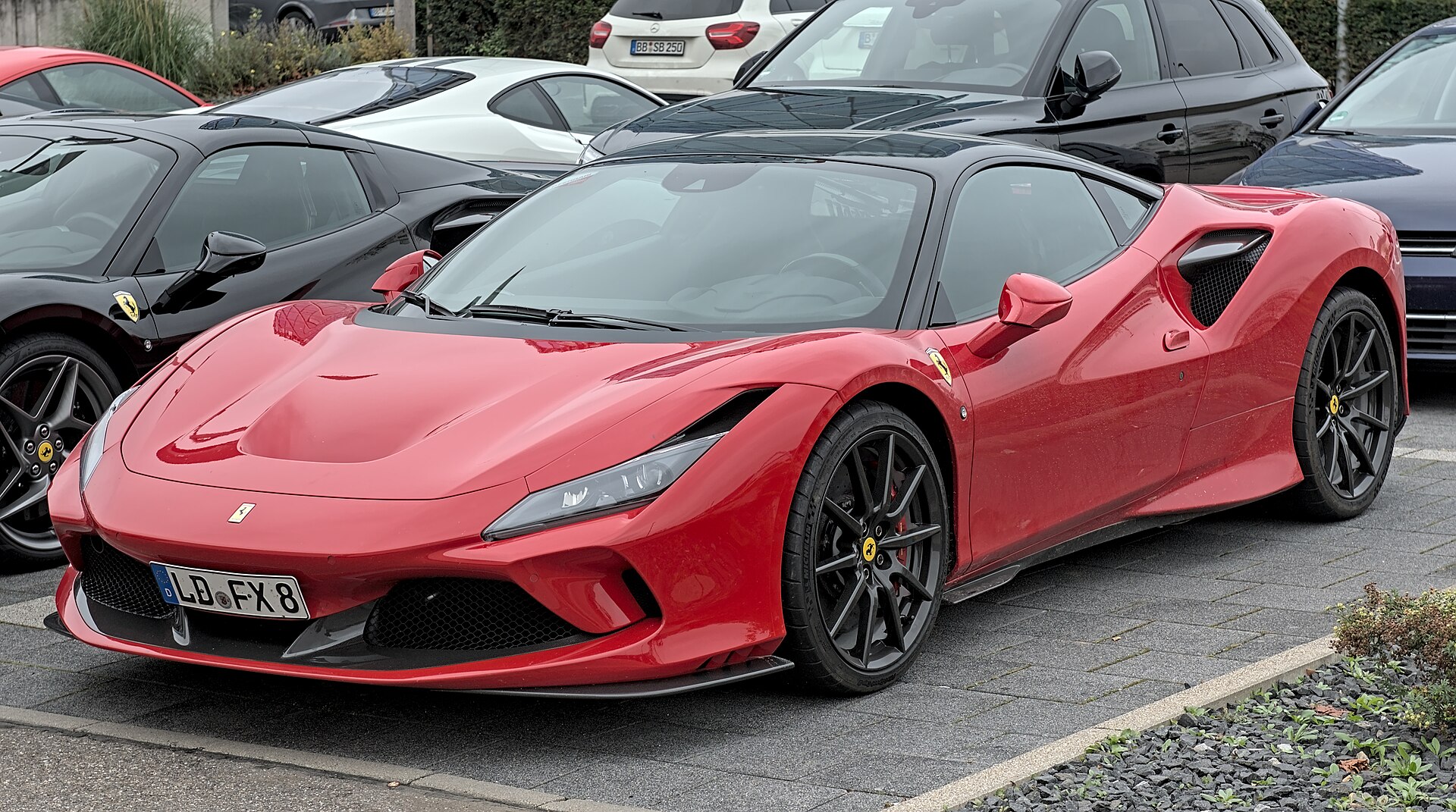
Ferrari has built mid-engine V8 berlinettas in a continuous line since 1975, and the F8 Tributo is where that line, in its non-hybrid form, currently comes to rest. Its 3.9-liter twin-turbo V8 produces 710 hp at 8,000 rpm and 568 lb-ft of torque through a seven-speed dual-clutch gearbox, per Ferrari's published specifications.
That said, the car that followed it changed the formula entirely. The 296 GTB pairs a 2.9-liter V6 with a plug-in hybrid system for a combined 819 hp, according to Ferrari, which leaves the F8 as the most recent Ferrari of its type without electrification.
Naturally, that status shapes the used market. What follows is a model-year reading of the published valuation data — where the coupé and the Spider sit today, how far apart they are, and which year gives a buyer the most car for the money.
How Long Was The Ferrari F8 Built?
The F8 Tributo was unveiled at the 2019 Geneva Motor Show, and the F8 Spider followed with a retractable hardtop that Ferrari quotes at 14 seconds to open or close. In the US, KBB lists both body styles from the 2020 model year onward.
The run was short. Ferrari stopped taking orders for both cars in March 2022, as Carscoops reported at the time.
The coupé's final model year is close to a footnote. A Ferrari spokesperson told Car and Driver that a single F8 Tributo was built for the 2023 model year for Ferrari North America, as relayed by Carscoops, while Spider production continued beyond the coupé.
Accordingly, a used F8 Tributo buyer is in practice choosing between three model years — 2020, 2021 and 2022. Production estimates for the full run vary; verify against authoritative sources before transaction.
What The Published Figures Say, Year By Year
Kelley Blue Book publishes an original MSRP and a current Fair Purchase Price for each model year of the F8. The figures below are KBB's, as retrieved in October 2026, from its Ferrari F8 valuation pages.
| Model year | Tributo original MSRP | Tributo Fair Purchase Price | Spider original MSRP | Spider Fair Purchase Price |
|---|---|---|---|---|
| 2020 | $275,780 | $373,000 | $302,500 | $295,000 |
| 2021 | $275,780 | $355,000 | $302,500 | $421,000 |
| 2022 | $280,947 | $439,000 | $308,068 | $446,000 |
| 2023 | $285,250 | $375,000 | $329,592 | $411,000 |
Two things stand out. First, every coupé figure sits above its original base MSRP — roughly 129 percent of base for a 2021 car and roughly 156 percent for a 2022, by our arithmetic on KBB's numbers.
Second, the progression is uneven. A 2020 coupé is listed above a 2021, a 2020 Spider is listed far below every other Spider, and the 2023 coupé figure describes a model year that Ferrari says amounts to one car.
Why The Numbers Sit Above MSRP
Keep in mind that the MSRP in each row is a base price. Very few F8s left Maranello at base, and the as-delivered sticker on a typically specified car was materially higher — by an amount we can only describe as estimated, because it differs on every car.
This is why the window sticker matters more than the headline percentage. A car that appears to trade above its original price may still have cost its first owner money once carbon fiber, lift, and paint are counted.
Why Some Rows Look Wrong
The 2020 Spider figure of $295,000 sits roughly $126,000 below KBB's 2021 Spider figure for a mechanically equivalent car. A gap of that size is more plausibly a product of a small sample than a real market discount, and we would not plan a purchase around it.
For more on how valuation guides behave when few cars change hands, see our note on thin-data depreciation figures. The same caution applies to the 2023 coupé row.
Launch Cars: Is A 2020 F8 Tributo Worth Considering?
Launch-year cars usually carry the lowest prices in a generation. On KBB's figures the F8 does not follow that pattern — the 2020 coupé is listed at about $373,000, some $18,000 above the 2021.
There is also a practical consideration. Ferrari's Genuine Maintenance program covers scheduled service for seven years from original delivery, which means a 2020 car reaches the end of that coverage a year before a 2021.
Overall, a 2020 car makes sense when the individual example is better — lower mileage, stronger specification, cleaner history — and priced accordingly. On the published figures alone, it does not earn its place over the following year.
The Spider Split
The coupé and the Spider behave differently, and the two main published sources describe that difference from opposite ends. In absolute dollars the Spider costs more; as a percentage of what it cost new, it has given up more.
iSeeCars estimates that the F8 Spider loses 30.7 percent of its value over five years, against 20.5 percent for the F8 Tributo. The same source puts the average used Spider listing at $467,357, across 28 cars nationally with an average of 4,494 miles.
KBB's year-by-year figures show how unevenly that premium is distributed. A 2021 Spider is listed about $66,000 above a 2021 Tributo, yet in 2022 the gap narrows to about $7,000.
For context, the original base MSRP gap between the two was roughly $27,000 in both years. In other words, the 2021 Spider premium is about two and a half times the original difference, while the 2022 Spider premium is about a quarter of it.
Note that the iSeeCars and KBB figures do not reconcile neatly, and we would not pretend that they do. They use different samples and different methods, and the honest reading is a range — which is exactly why a specific car's sticker, mileage and history should carry the decision.
Where Values Settle After The 296
The conventional expectation is that a successor pushes its predecessor down. The published figures for the F8 do not show that, at least not yet.
iSeeCars puts the average used 296 GTB at $353,355, within a range of $310,482 to $399,999 across 20 cars. That sits level with KBB's figure for a 2021 F8 Tributo, despite the 296 GTB's higher starting MSRP of $333,255.
What's more, iSeeCars estimates a five-year loss of 23.7 percent for the 296 GTB against 20.5 percent for the F8 Tributo. On that measure the older, non-hybrid car is the one holding its value better.
This is consistent with a pattern we have described in our used Ferrari depreciation sweet spot analysis, where the last car of a given configuration tends to find a floor sooner than the car that replaced it. Whether that floor holds for the F8 is a forecast, and we would treat it as one.
For buyers weighing the hybrid route instead, our comparison of the McLaren Artura and Ferrari 296 covers that decision in detail. Buyers who would rather step back a generation should read our guide to the used Ferrari 488, which shares the F8's basic architecture at a lower entry price.
Specifications That Move The Price
Because the drivetrain is the same across every model year, the price differences between individual F8s come down to specification and provenance. Some of the factors that carry the most weight include but are not limited to:
- Options content. Carbon fiber packages, the suspension lifter and racing seats account for much of the difference between a base sticker and an as-delivered one. Ask for the original window sticker and price the car against that figure.
- Paint and interior. Extra-range and special-order colors tend to be advertised at a premium over standard finishes. The size of that premium is car-specific and should be treated as estimated until comparable listings support it.
- Mileage profile. The iSeeCars Spider sample averages under 5,000 miles, so a car with meaningfully more use sits outside the bulk of the market. That can be an opportunity for a buyer who intends to drive.
- Service history and coverage. Confirm the original in-service date and the remaining term of the seven-year maintenance program with an authorized dealer. Our breakdown of Ferrari service costs by model sets out what follows once that coverage ends.
- Books, tools and ownership. A single-ownership car with complete books, both keys and its accessories is easier to resell. A pre-purchase inspection (PPI) at an authorized Ferrari dealer remains the standard for any car outside the Ferrari Approved program.
All of these matter more than the model year on the title. Two 2021 coupés can sit tens of thousands of dollars apart on specification alone.
Editorial Recommendation
The published figures support a clear order of preference, with the caveat that each one is a guide price and not a transaction. Here is how we would approach the F8 today:
- Best value: 2021 F8 Tributo. KBB's Fair Purchase Price of about $355,000 is the lowest of the three practical coupé years, and the private-party figure is about $341,000. The car has a year more maintenance coverage than a 2020.
- Pay the premium only for the right car: 2022 F8 Tributo. At about $439,000 on KBB, the final full-year coupé costs roughly $84,000 more than a 2021 for the same drivetrain. That is a collector's premium, and it is only justified by specification and mileage.
- For an open car: 2022 F8 Spider. KBB lists it at about $446,000, only about $7,000 above the 2022 coupé. Buyers set on a 2021 should compare the Spider's roughly $66,000 premium against the iSeeCars five-year estimate before committing.
- Verify before acting: 2020 Spider and 2023 coupé. Both rows in the published data look like thin-sample results. Price these cars from current comparable listings, never from the guide figure.
All of the above assumes a clean, properly documented car. Buyers planning to finance should also read our guide to exotic car financing, since lender terms on a car of this age vary considerably.
Where To Go From Here
The F8 Tributo rewards a patient buyer who prices the individual car and treats the model year as a starting point. After all, the same engine and gearbox sit behind the seats of every example.
For the wider picture — current lineup, allocation reality and our other buying playbooks — visit the Ferrari marque hub. Readers considering the limited-run cars above the F8 will find that context in our guide to the Ferrari Special Series.