Buying a Mercedes-Maybach S 580 or S 680: Spec Strategy, the Two-Tone Premium, and Where Depreciation Bites
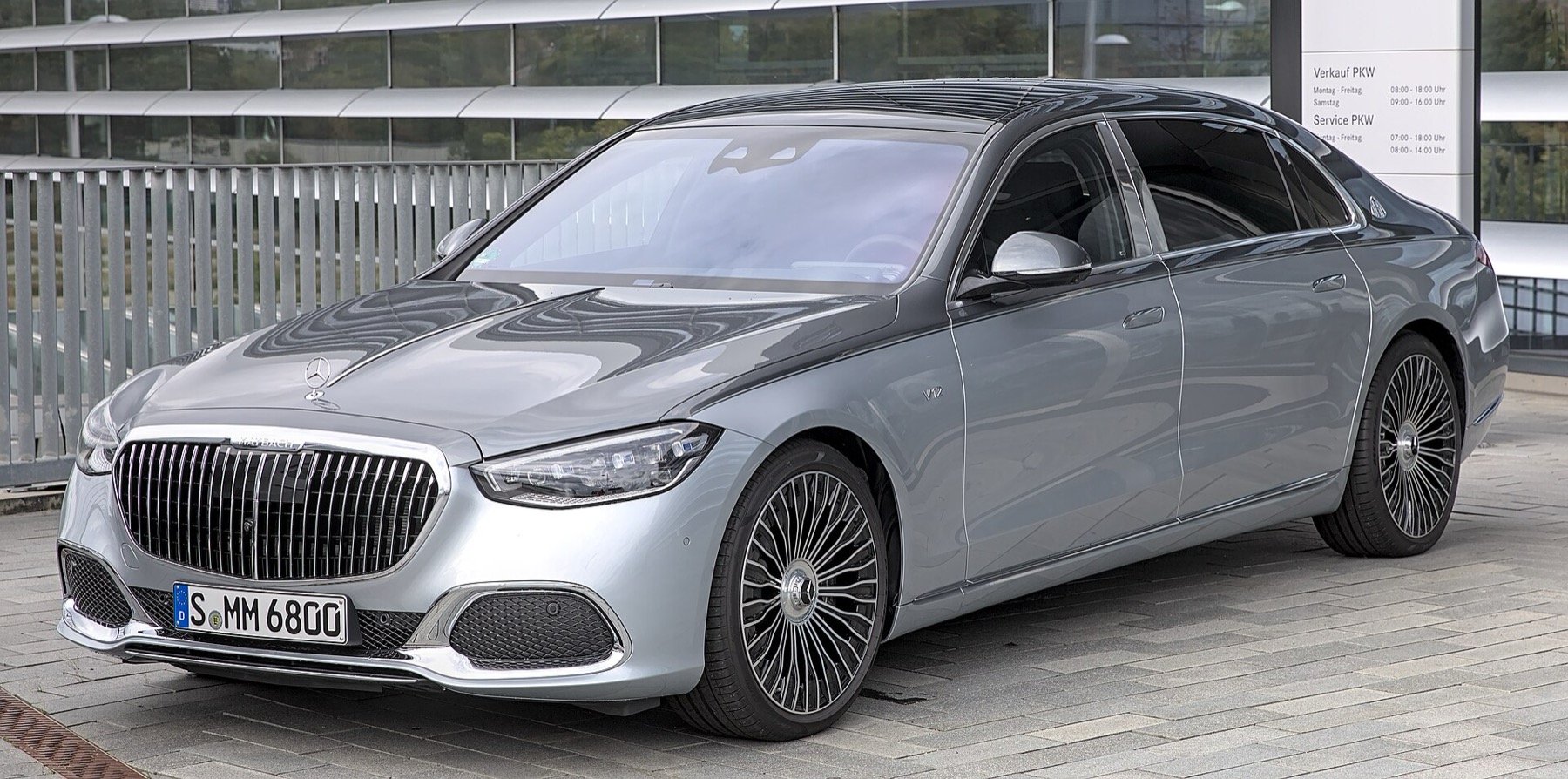
The rear compartment of a Mercedes-Maybach S-Class is the only place in the current Mercedes-Benz lineup where the car is explicitly designed around someone who is not driving it. That single design premise governs everything about how the Z223 should be specified, bought, and — eventually — resold.
Mercedes-Benz USA lists the 2025 Mercedes-Maybach S 580 4MATIC with a starting MSRP of $199,050 and the twelve-cylinder S 680 4MATIC at $237,600, before destination and before a single Manufaktur box is ticked (Mercedes-Benz USA). In practice, the cars that reach US dealers rarely sit near those numbers. A representative Maybach on a dealer floor carries somewhere between $25,000 and $60,000 of options, which is the first fact a buyer needs to internalize before shopping.
The V8 Is the Better Car, and the V12 Is the Better Story
The S 580's 4.0-liter twin-turbocharged V8 with the integrated starter-generator is, by any ordinary measure, the more complete powertrain. It restarts imperceptibly, it carries the car's mass without drama, and it does not ask the owner to plan around fuel-economy penalties or the service intervals of a low-volume engine.
The S 680's M279 V12 is a different proposition entirely. It exists because a handful of buyers in the United States, China, and the Gulf still want twelve cylinders in a chauffeur sedan, and because Mercedes has decided to keep building it while emissions rules permit.
What the V12 delivers is not speed — the V8 car is barely slower in any real-world scenario — but a particular quality of torque delivery at low load, where the engine never seems to be working. Whether that is worth roughly $38,500 at MSRP is a question about the owner, not the car.
From a resale standpoint, the answer is clearer. The V12 premium does not survive the first owner intact; used-market listings routinely show S 680 examples asking a far narrower premium over comparable S 580 cars than the original MSRP gap would suggest. The V12 is a spend, not a store of value.
The Executive Rear Seat Package Is the Only Option That Defends Itself
If the Maybach's premise is the rear compartment, the Executive Rear Seat package is the option that delivers on it. It converts the right-rear position into a reclining seat with a deployable calf rest and a folded front passenger seat, and it is the single feature most likely to be searched for by the second buyer.
The practical consequence is that a Maybach without it is a $200,000 sedan pretending to be a $230,000 one. Cars specified without the rear-seat package sit longer on dealer lots and trade closer to a well-optioned S 580 Mercedes-Benz S-Class than to their Maybach peers.
The adjacent options — the rear refrigerated compartment, the silver-plated champagne flutes, the MBUX rear tablet — are pleasant and largely irrelevant to residual value. They are consumables of a kind: enjoy them, but do not account for them as assets.
Two-Tone Paint: A Real Premium, With Conditions
The two-tone finish is the Maybach's visual signature and a genuine hand-applied process, with the dividing line laid by hand rather than by machine. It is also expensive — a five-figure option in most configurations, and more when ordered through Manufaktur as a bespoke pairing.
The premium is real on the used market, but it is conditional. Conservative pairings — obsidian black over a deep metallic, or a nautical blue over silver — carry the option forward. Unusual or high-contrast combinations narrow the buyer pool sharply, and a narrow buyer pool on a $200,000 sedan means months on market.
The same logic governs the broader Manufaktur programme. A paint-to-sample shade or a bespoke leather pairing is an expression of the first owner's taste, and the second owner is being asked to adopt it. Price accordingly: assume most bespoke content returns little, and treat anything it does return as a surprise.
The Night Series and similar special editions sit in a middle position. They are volume-limited enough to attract attention and conventional enough in palette to avoid the narrow-pool problem, but they are not production-capped in the way that creates collector behavior. Expect a modest premium, not an appreciating asset.
Why the Maybach Depreciates Faster Than a Ghost or a Flying Spur
This is the question that matters most, and the answer has three parts.
First, volume. Mercedes builds the Maybach S-Class on the same line, on the same platform, as the standard S-Class, and produces it in numbers that no Rolls-Royce approaches. Scarcity is a load-bearing part of a Ghost's residual, and the Maybach does not have it.
Second, the shadow of the donor car. A three-year-old S 580 4MATIC — the regular one — is visibly and mechanically most of a Maybach, and it costs dramatically less used. That substitute suppresses the Maybach's used price in a way that has no analogue for the Rolls-Royce Ghost used market, where nothing else in the Mercedes or BMW catalog serves as a near-equivalent.
Third, buyer behavior. Maybach owners lease at high rates and turn cars over on short cycles, and industry depreciation tracking from iSeeCars has consistently placed large German luxury sedans among the fastest-depreciating vehicle segments over five years. A steady supply of three-year lease returns arriving into a market of buyers who could instead buy a standard S-Class does not produce firm pricing.
Scarcity is a load-bearing part of a Ghost's residual, and the Maybach does not have it.
None of this is a criticism of the car. It is simply the reason the second owner is the one getting the better transaction, and why we would point most readers toward a used example rather than an order.
The Two-Year-Old Car Is the Value Play
The steepest portion of the Maybach's depreciation curve occurs in the first twenty-four months, which is also the period during which the car remains under its original four-year, 50,000-mile Mercedes-Benz new-vehicle limited warranty (Mercedes-Benz USA). A buyer who arrives at month twenty-four is therefore absorbing the smallest remaining share of the curve while retaining roughly half the original coverage.
Mercedes-Benz Certified Pre-Owned extends coverage beyond the original term and adds a documented inspection, and Maybach examples are well represented in the CPO inventory precisely because of the lease-return volume described above. Verify current CPO terms and pricing directly with Mercedes-Benz USA or the selling dealer before transacting; program terms change by model year and by region.
What that timing buys, beyond price, is selection. At two years there are enough cars in the market to be specific about configuration rather than accepting whatever a dealer happens to hold — and configuration, on this car, is most of the decision.
What to Verify Before You Transact
A pre-purchase inspection on a Maybach should focus on the systems that are expensive and specific to it, not on the engine. The AIRMATIC air suspension with E-ACTIVE BODY CONTROL, the rear-axle steering, and the rear-compartment electronics are where the meaningful out-of-warranty exposure lives.
On a two-tone car, inspect the dividing line in direct sunlight for any evidence of refinish work. Repairing a hand-applied two-tone correctly is a specialist operation, and a poor repair is both visible and difficult to price.
Request the original window sticker. On a car where option content can approach a third of the transaction price, the sticker is the only reliable record of what was actually ordered, and a seller who cannot produce it is asking you to take the configuration on faith.
Editorial Recommendation
- Take the S 580. The V8 is the more complete powertrain for the way the car is used, and the V12's MSRP premium does not survive into the used market.
- Insist on the Executive Rear Seat package. It is the option that makes the car a Maybach rather than a heavily optioned S-Class, and it is the one the next buyer will search for.
- Buy two to three years old. The first-owner depreciation is the product here; let someone else pay for it while factory coverage remains.
- Two-tone, but conservatively. A restrained pairing carries forward. A bespoke Manufaktur combination is a personal expenditure, not an investment.
- Get the window sticker and a specialist PPI. Air suspension, rear-axle steering, and rear-compartment electronics, in that order.
Readers weighing the Maybach against its direct rivals should read our Bentley Continental GT used-market analysis for the comparable Bentley depreciation picture, and our DB12 versus Continental comparison for how grand-tourer residuals behave differently from chauffeur-sedan residuals. Further coverage of the marque and its lineup is collected on our Mercedes-Maybach brand hub, and adjacent segment analysis sits in luxury sedans.
Production volumes, option pricing, and certified pre-owned program terms vary by model year and region; verify every figure against Mercedes-Benz USA or an authorized dealer before you transact.