The Best Year to Buy a Used Rolls-Royce Ghost: Series I, Series II, and the 2021 Architecture Reset
F
ew cars in the modern luxury market separate purchase price from ownership cost as dramatically as the Rolls-Royce Ghost. A car that opened at $245,000 in 2010 can be bought today for well under six figures, which is precisely why the model year you choose matters more here than the color of the coachline.The Ghost has now run through two distinct generations and two separate facelifts, and the naming is a genuine trap for buyers. Rolls-Royce has used the "Series II" designation twice — once for the 2014 refresh of the first-generation car, and again for the 2024 refresh of the second — so a listing described as a "Series II Ghost" may be a decade-old car or a nearly current one.
This guide separates those eras, prices them against published depreciation data, and identifies where the cost of ownership stops tracking the purchase price. For the wider marque context, see our Rolls-Royce brand hub; for how the Ghost sits against its segment rivals, see luxury sedans.
Generation One, Series I: 2010–2014
The original Ghost launched for the 2010 model year at a base MSRP of $245,000, according to Kelley Blue Book. It used a 6.6-liter twin-turbocharged V12, rear-wheel drive, and a heavily reworked BMW 7 Series structure — a point that mattered enormously to the original price and matters almost not at all to a buyer today.
These are the cheapest Ghosts on the market, and the reason is not condition alone. Edmunds currently lists used Ghost inventory spanning $77,995 to $439,750, and the bottom of that range is populated almost exclusively by early Series I cars.
An early Ghost at $80,000 is not a bargain in any meaningful sense — it is a $245,000 car with $245,000 service intervals attached. Keep in mind that the V12, the air suspension, and the electronics were never engineered against a used-market price point.
The 2010–2011 cars in particular carry the first-year burden: early infotainment hardware that cannot be updated to later specification, and a growing population of examples that have passed through three or more owners. What's more, the Extended Wheelbase variant arrived in 2011, adding roughly four inches of rear legroom and creating a second, thinner used market that trades on a different logic entirely.
Generation One, Series II: 2015–2020
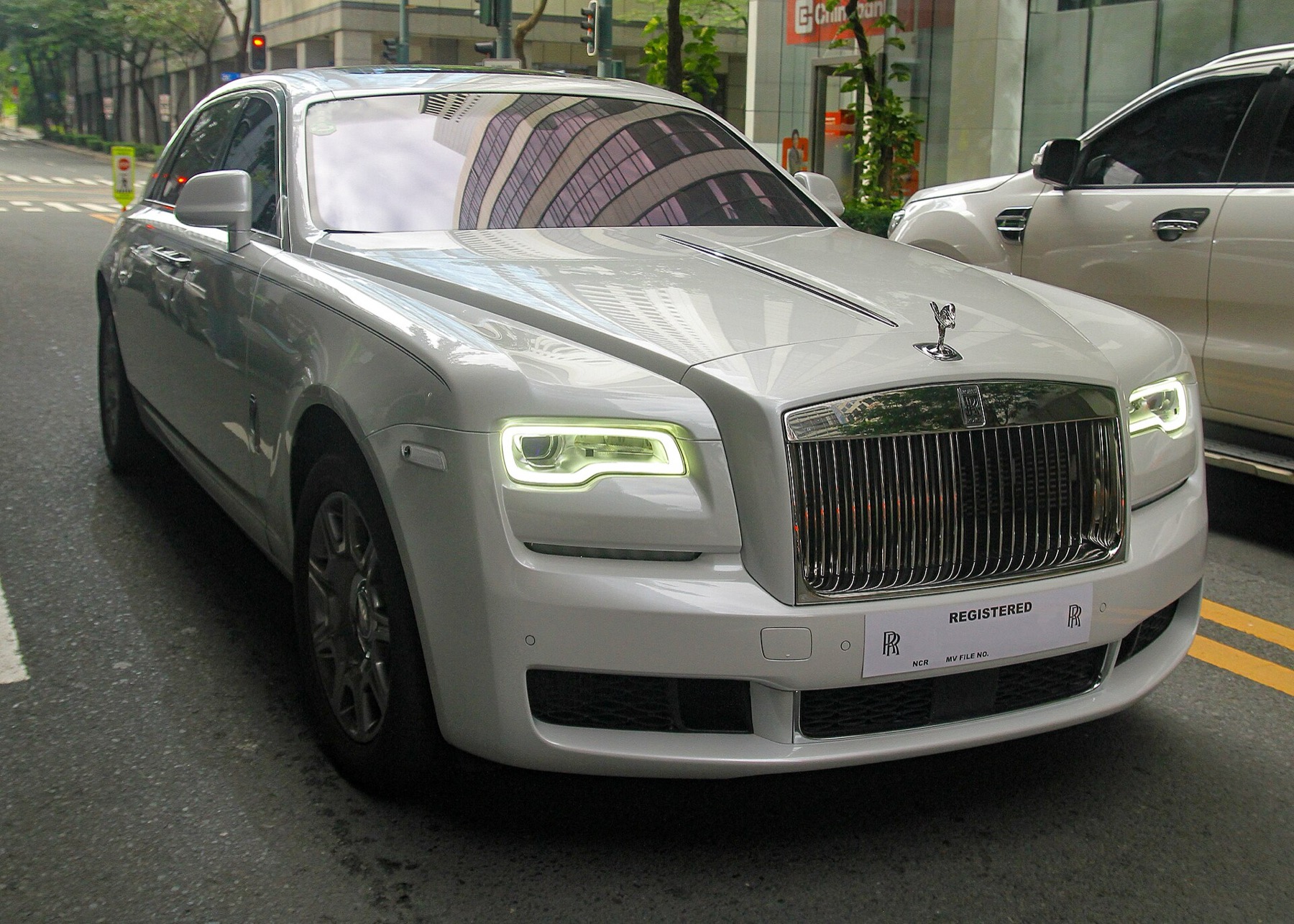
Rolls-Royce introduced the first Series II at the 2014 Geneva Motor Show, reaching US buyers as a 2015 model. The changes were characteristically restrained — revised front-end treatment, updated headlights, a reworked dashboard, and a satellite-aided transmission that read the road ahead to pre-select gears.
This is where the value case sharpens considerably. A 2016 Ghost now carries an average asking price of approximately $112,038, representing a decline of about 62.2% from original MSRP according to aggregated listing data — a car that has already absorbed the steepest portion of its curve while retaining the refreshed hardware.
The Black Badge arrived in 2016 as a factory variant, not an appearance package. It brought a darkened Spirit of Ecstasy, blacked-out brightwork, additional output, and a firmer chassis tune — and it is the single option that most reliably supports resale on first-generation cars.
The 2021 Architecture Reset
The second-generation Ghost arrived for the 2021 model year and represents the most significant break in the model's history. It moved onto the Architecture of Luxury — the aluminum spaceframe shared with the Phantom VIII and Cullinan — ending the BMW-derived structure entirely.
The engineering consequences are substantial rather than cosmetic. All-wheel drive and all-wheel steering became standard, and the car introduced the Planar Suspension System, which Rolls-Royce describes as incorporating a world-first upper wishbone damper alongside a Flagbearer camera system that reads the road surface ahead and pre-adjusts the air suspension.
Base MSRP for the 2021 car was $332,500, rising to approximately $337,850 with destination and gas-guzzler tax, per Motor Authority. That same report documents a test car carrying $102,375 in options — a figure that tells you most of what you need to know about how these cars were specified when new.
The second-generation Black Badge followed in October 2021, and a second Series II facelift was revealed on October 9, 2024, bringing illuminated Pantheon grille treatment and revised lighting signatures at a $355,000 starting point.
Where the Service-Cost Cliff Sits
This is the part of the Ghost conversation that listing sites do not surface, and it deserves plain language. Rolls-Royce covers new cars under a four-year warranty with included scheduled maintenance, which means the meaningful financial boundary is the expiry of that coverage, not any particular odometer reading.
On a first-generation car, that coverage lapsed years ago on every example in the market. The consequence is that a Series I Ghost is a fully self-funded ownership proposition — air suspension components, V12 ancillaries, and the brake system all price against the original MSRP rather than the current one.
The practical rule is that the cliff is not a mileage figure but a paperwork one. A car with continuous franchised-dealer service history and a transferable extended warranty occupies a different financial category than an identical car without either, and the gap between them is far larger than the price difference usually reflects.
Be aware that the Provenance certified pre-owned program is the mechanism the marque uses to manage exactly this problem. A Provenance car carries factory-backed extended coverage and a documented inspection, and it is the only route by which a used Ghost buyer transfers meaningful risk back to Rolls-Royce.
Which Options Support Value
Option specification on a Ghost is not decoration — it is the largest single variable in used pricing after condition. The options that hold value share a common trait: they cannot be replicated after the fact.
- Starlight Headliner. Hand-woven fiber-optic lights set into the roof lining, ordered new at significant cost and effectively impossible to retrofit to original standard. Its absence is the most common reason an otherwise well-specified Ghost sits unsold.
- Black Badge. A factory variant with distinct output, chassis tune, and finish. Because it is built rather than fitted, it supports a durable premium over an equivalent standard car.
- Extended Wheelbase. Adds rear legroom and appeals to the chauffeur-driven buyer. It narrows the audience but strengthens it, and EWB cars tend to show shorter time-on-market in the segments that want them.
- Paint-to-Sample and bespoke commissions. Documented PTS work supports value when the documentation survives; without the build record, an unusual color reads as a repaint and works against the car.
- Rear theater and picnic-table configurations. These matter primarily on EWB cars, where the rear compartment is the point of the vehicle.
All of these share the same underlying logic: the market pays for what the factory did and discounts what an owner added later. Note that the correct sequence is to identify the specification you want first and then find the best condition example of that specification, never the reverse.
Reading the Depreciation Curve
Published data puts Ghost depreciation at approximately 41.1% over five years, with roughly 21.8% at three years, 55.6% at seven years, and about 70% at ten years, according to iSeeCars resale value data. Treat these as directional figures for the nameplate rather than precise predictions for any individual car.
The shape matters more than any single number. The curve is steepest between years three and seven, which means the buyer who acquires at year seven has let a prior owner absorb the decline while inheriting a car that is still structurally modern.
That logic is what makes the 2015–2017 window the strongest value-to-condition proposition in the range. These cars carry the Series I facelift hardware, sit near the flattening portion of the curve, and are old enough that the surviving population has largely self-selected toward owners who maintained them.
The second-generation cars tell a different story and require a different judgment. A 2021 Ghost has now absorbed roughly the five-year portion of its curve from a $332,500 base, but it also sits close enough to current production that it competes against a facelifted car with a $355,000 sticker — a comparison that suppresses asking prices for the earliest second-generation examples.
Editorial Recommendation
- Best value-to-condition: 2015–2017 Series I facelift, standard wheelbase, with Starlight Headliner and continuous franchised service history. This is where the depreciation curve has flattened and the hardware is post-refresh.
- Best car regardless of value: 2021 or later, second generation. The Architecture of Luxury platform, Planar suspension, and all-wheel steering represent a genuine engineering generation ahead of anything before it.
- Best risk-adjusted purchase: Any Ghost still inside Provenance certified pre-owned coverage. The premium over a private-sale equivalent is smaller than the exposure it removes.
- Avoid: 2010–2011 cars without documented service history, and any example where the seller cannot produce build documentation for unusual paint or trim.
- Non-negotiable: A pre-purchase inspection at a Rolls-Royce franchised dealer before any transaction, on every car in every year range discussed here.
The Ghost rewards the buyer who treats specification and documentation as the primary variables and price as the secondary one. Remember that the cheapest example in any listing set is cheap for a reason the listing does not state — and on a car of this kind, that reason is almost always deferred.
For broader marque background and model positioning, see the Rolls-Royce brand hub. For cross-shopping against comparable cars, our luxury sedans category covers the segment, and the Bentley Continental GT model-year guide applies the same used-market framework to the Ghost's closest British rival.