The Audi R8 on the Used Market: Where the Last V10 Supercar's Depreciation Settles
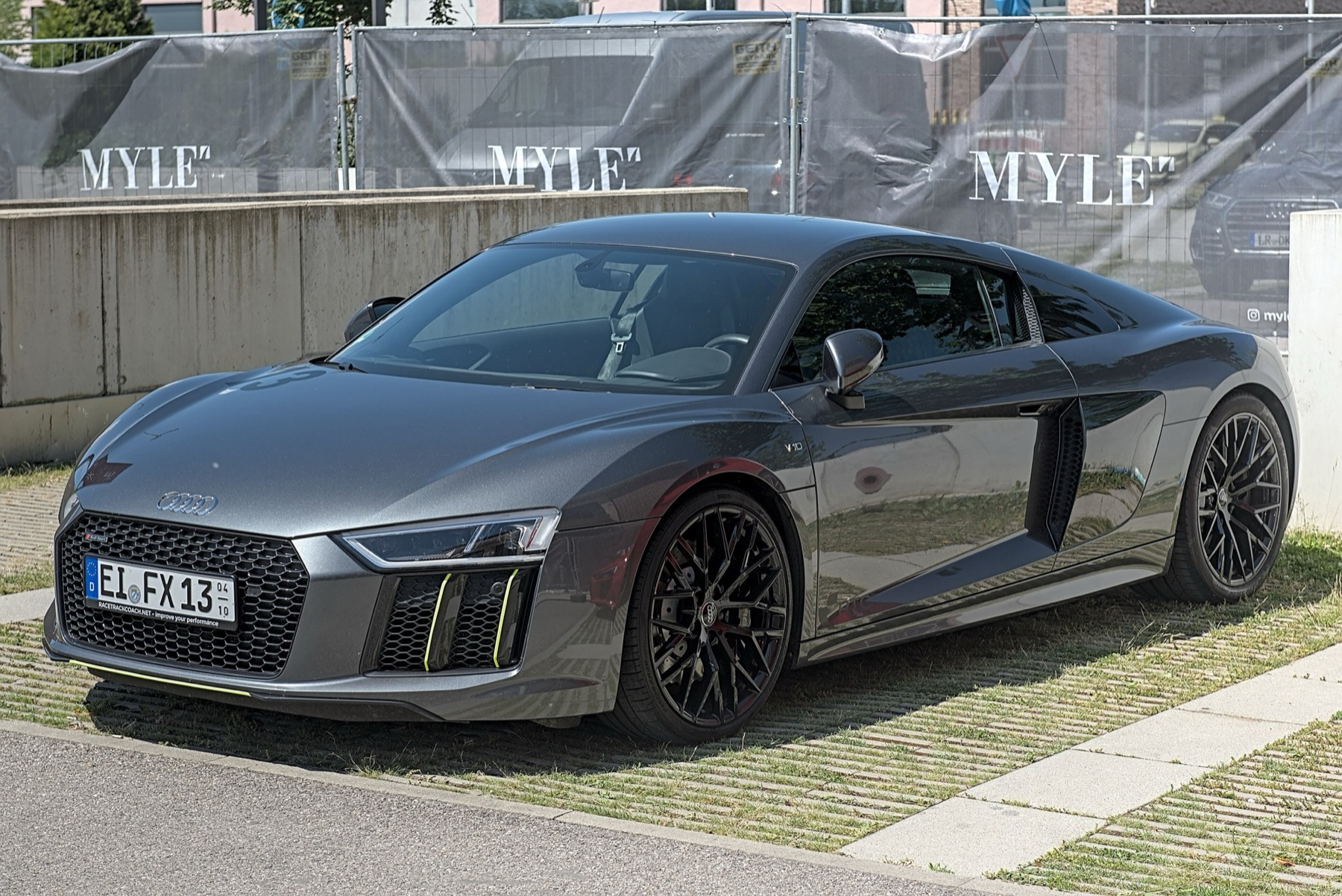
The
naturally aspirated engine is, by most measures, an endangered species. Emissions regulation, electrification, and the efficiency math of forced induction have quietly retired the high-revving multi-cylinder layouts that defined the supercar for two decades.The Audi R8 was among the last to go. When the final R8 V10 left Audi's Böllinger Höfe line in 2024, it took with it one of the few remaining naturally aspirated V10 engines sold in a road car.
That ending is precisely why the used R8 is worth studying now. A car stops depreciating on the old schedule the moment the market reclassifies it from last year's model to the last of its kind.
Why the R8 Sits at a Depreciation Inflection Point
The R8 occupies an unusual position. It was built and serviced like an Audi, which kept running costs sane, yet it shared its engine architecture and much of its chassis with the Lamborghini Huracán.
That dual identity is the whole story of its residuals. The Audi badge drove steep early depreciation, while the engine underneath is the same naturally aspirated 5.2-liter V10 that will keep the car desirable long after the curve flattens.
End-of-production status compresses that timeline. Once a model is discontinued with no direct successor, the supply of clean examples is fixed, and the depreciation floor arrives sooner than it does for a car still in production.
What the R8 Cost New
Context for any used analysis starts with the original window sticker. These are approximate manufacturer figures; verify against Audi records or an MSRP archive before relying on them for a specific build.
- First-generation R8 4.2 V8 (2008). Launched at approximately $114,000–$120,000, the entry V8 was the volume car and is the depreciation floor today.
- First-generation R8 5.2 V10 (2009–2010). Roughly $146,000–$156,000 at launch, the V10 added the engine that now anchors the car's collectibility.
- Second-generation R8 V10 (2017). Base price around $164,000, with the V10 Plus near $190,000–$195,000.
- Final R8 V10 GT RWD (2023). A send-off model at approximately $253,000, limited to 333 units globally.
Those figures matter because every depreciation percentage you read on a valuation site is calculated against them. Keep in mind that a number quoted without its original MSRP tells you very little.
Where Used Values Are Settling
Here the facts discipline matters most. Live retail values move weekly, so treat every figure below as estimated and market-observed, and confirm it against the sources named.
For the first-generation V8, estimates cluster in the high-$50,000s to low-$80,000s depending on mileage, transmission, and condition. That makes it among the most accessible naturally aspirated mid-engine cars of its caliber on the market.
First-generation V10s, especially the gated six-speed manual cars, sit higher and form the clearest appreciating subset. They are frequently estimated from roughly $90,000 into the $140,000s and beyond for low-mileage manual examples.
Second-generation V10 examples are estimated broadly across the $110,000–$170,000 range. The spread is driven by model year, V10 Plus or Performance trim, and mileage rather than by any single factor.
For condition-tiered numbers, Hagerty Valuation Tools is the appropriate reference. It tracks the R8 across concours, excellent, good, and fair tiers, and it is where early-appreciation signals on the manual V10 tend to surface first.
The Generation Split That Decides the Buy
The two generations are different propositions, and conflating them is the most common buyer error. Note that they share a name and an engine family but little else in character.
First generation (Type 42, 2008–2015). Offered both the 4.2 V8 and the 5.2 V10 and, critically, a gated six-speed manual. It is the enthusiast's R8 and the one with the clearer collectible trajectory.
Second generation (Type 4S, 2017–2023). V10 only, no manual, S tronic dual-clutch exclusively. It is faster, more refined, and more usable daily, though the absent manual removes one lever of long-term desirability.
If the priority is driving engagement and value retention, the conversation narrows to the first-generation gated-manual V10. That is the same logic that governs the gated-manual supercars worth seeking out.
The Spec Details That Move Price
Within each generation, a handful of options swing value more than mileage does. Here is where the residual logic earns or loses you real money.
- Transmission. The gated manual, first-generation only, commands a meaningful premium and is the single biggest value lever on the car.
- Engine. V10 over V8, always, for both performance and residual logic.
- Body style. The coupe generally holds value better than the Spyder among collectors, though the Spyder trades that gap for open-air usability.
- Trim. V10 Plus and later Performance trims carry more power and stronger resale than base V10s.
This is the same residual logic that shapes the used-Ferrari depreciation sweet spot. The rarest, most analog configuration finds its floor first and climbs first.
Why the Engine Is the Whole Investment Case
Strip away the badge debate and the R8's long-term value rests on one component. The 5.2-liter V10 is a high-revving, naturally aspirated unit from the same family that powered the Lamborghini Gallardo and Huracán.
It produced roughly 525 horsepower in early first-generation V10 form and climbed past 600 in later V10 Plus, Performance, and GT variants — manufacturer figures that should be confirmed per model year. No turbocharger, no hybrid assistance, and a redline north of 8,000 rpm.
That specification is now effectively unbuildable under current emissions and efficiency rules. When a drivetrain cannot be reproduced, the surviving examples become the supply, and that is the mechanism beneath every appreciation argument for the car.
The Curve: Steep Drop, Then a Floor
The R8's depreciation pattern is textbook for a badge-mismatched supercar: a steep early plunge followed by a flattening floor as the engine becomes the story. Understanding which half of that curve a given car is on is the entire exercise.
iSeeCars depreciation studies have repeatedly placed the R8 among sports cars with heavy early five-year depreciation. Figures are commonly cited above 50%, though the exact percentage varies by study year, so check the current iSeeCars analysis rather than an older headline.
The R8 did not just lose a model when production ended; the market lost an engine that current regulation will not let anyone build again.
The encouraging half of that pattern is what comes next. A car that has already absorbed the bulk of its depreciation, and whose engine cannot be replicated under current rules, is structurally positioned to stop falling.
Ownership Economics Before You Sign
A low entry price is not the cost of ownership. The R8 shares consumables and service intervals with serious machinery, and the savings versus its Lamborghini cousin are real but not infinite.
The Audi dealer network keeps maintenance more rational than exotic-marque pricing. That said, clutch service on dual-clutch cars, tires, and the eventual major service still run supercar money.
Budget honestly for these before committing. The framework in the real cost of supercar ownership applies directly, and a clean pre-purchase inspection (PPI) is non-negotiable on any example.
Editorial Recommendation
For most buyers seeking the naturally aspirated V10 experience at the depreciation floor, the value case is clearest at the two ends of the range. Name the spec before you shop, then hold out for it.
- The driver's pick. A first-generation R8 5.2 V10 with the gated six-speed manual, coupe body, and documented service history. It is the configuration with the strongest floor and the genuine appreciation case.
- The usability pick. A second-generation R8 V10 from 2017–2019, V10 Plus trim, lower mileage, bought well into its depreciation curve. It delivers the daily-usable supercar at a fraction of original MSRP.
- The value pick. A clean first-generation 4.2 V8 manual, the most affordable entry to the bloodline, with the caveat that it lacks the V10 that anchors long-term value.
Across all three, prioritize documented service history, books and tools, and a clean PPI over a marginally lower price. For broader context, see the Audi marque hub; for the same depreciation-floor logic under a different badge, the used Mercedes-AMG GT analysis is a useful companion.
Every production figure and value cited here should be confirmed against Hagerty, iSeeCars, and manufacturer records before any transaction. Treat the ranges as a starting framework, not a quote.