The Porsche Carrera GT on the Collector Market: Why the Last Analogue V10 Hypercar Keeps Climbing
Porsche
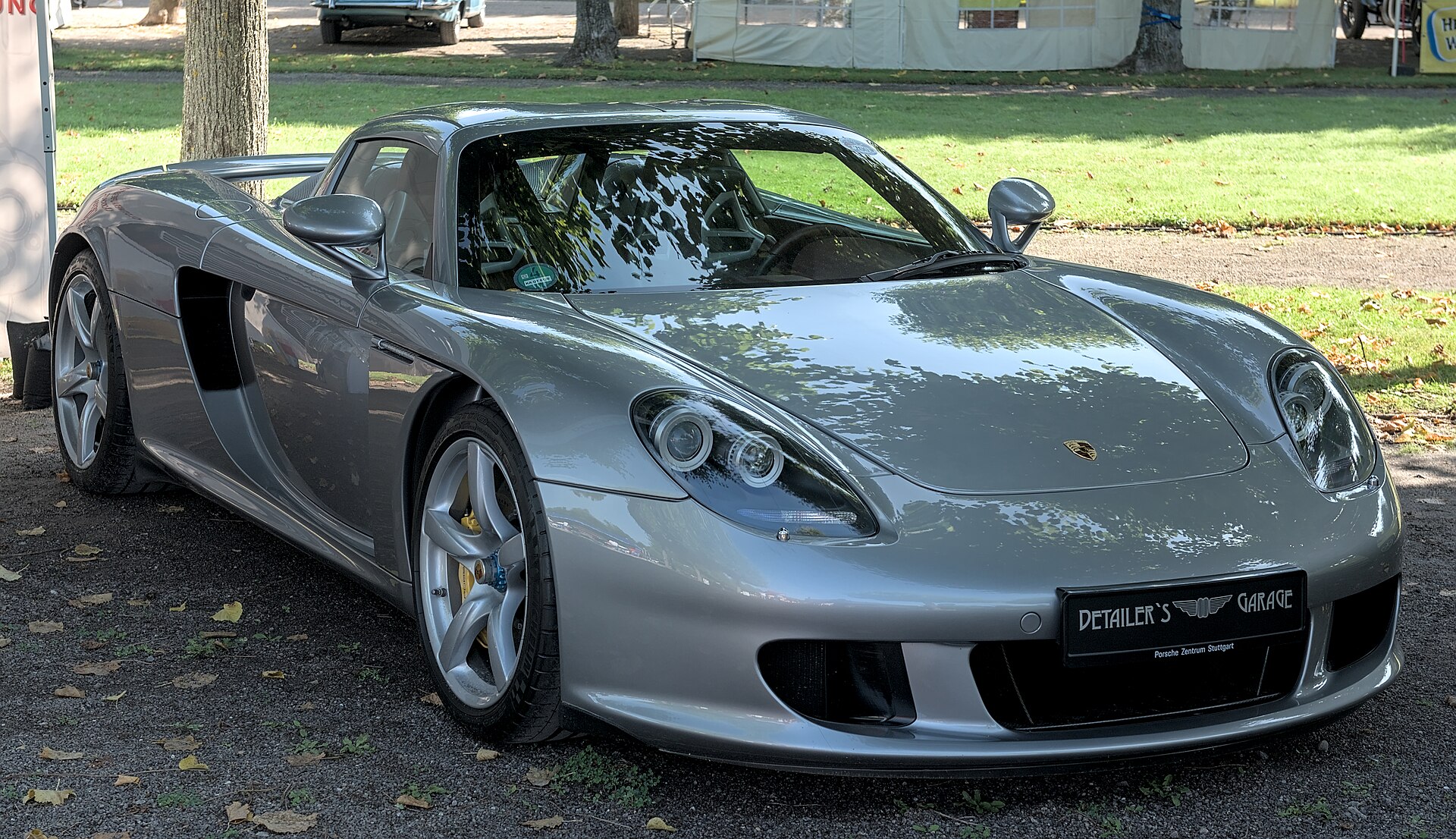
built 1,270 Carrera GTs between 2004 and May 2006, and period production records put 644 of them in US specification. When new, the car carried a US MSRP of approximately $440,000. Some sources list $448,400, so the figure varies slightly depending on whether destination and options are included.Today, Hagerty's valuation tools put a good-condition, average-spec 2005 example at about $1.3 million. That is roughly three times the original sticker. For a car once discussed mainly for its unforgiving manners, the shift says a great deal about what the collector market now rewards.
From Feared Widowmaker To Blue-Chip Collector Car
The Carrera GT arrived with a reputation that preceded it. It paired a high-revving V10 with a six-speed manual, a ceramic clutch that rewarded precision and punished hesitation, and no stability control. Early press coverage and a handful of high-profile crashes cemented the nickname, and for years that reputation weighed on demand.
That said, the same qualities that made the car intimidating in 2005 are now precisely what collectors seek. The analogue hypercar era closed shortly after the Carrera GT's production ended. Its successor, the 918 Spyder, moved to hybrid power and a dual-clutch transmission.
As a result, the Carrera GT now sits in a narrow category of its own. It is a mid-engine Porsche with a naturally-aspirated V10, a gated-feel manual and a carbon-fiber monocoque. No later Porsche has repeated that recipe.
The Value Curve, Source By Source
The Carrera GT's trajectory is easiest to read through published data rather than anecdote. Keep in mind that Hagerty updates its guide periodically, so the figures below reflect its most recent published snapshots and should be rechecked before any transaction.
The key reference points currently on record include:
- Typical good-condition value. Hagerty's price guide places a 2005 Carrera GT in good condition with average spec at approximately $1.3 million (Hagerty).
- Excellent and concours-tier values. Hagerty's market commentary lists the #2 (excellent) value at $1.4 million and the #1 (concours) value at $1.75 million (Hagerty).
- Recent public sale. A 2005 example sold on Bring a Trailer for $1,396,500 on April 23, 2025, according to Hagerty's sales record.
- Public-sale record. Hagerty reports the record at approximately $2.2 million, set in 2022, the high point of the post-pandemic collector boom.
- Online benchmark. An earlier Bring a Trailer sale at $1.9 million was reported by Bloomberg as an online-auction record for the model.
All of these data points tell a consistent story. Values peaked in 2022, softened by approximately 7 percent according to Hagerty, and have since settled on a higher floor than the car occupied before the boom.
What's more, sentiment appears to be turning again. Porsche's own newsroom noted that the Carrera GT was named to the 2026 Hagerty Bull Market List, which Hagerty reserves for vehicles it expects to appreciate.
Why The Mechanical Recipe Commands A Premium
Collectors pay for what cannot be built again, and the Carrera GT's specification is a clear case. The 5.7-liter V10 traces its lineage to a Le Mans prototype program, and it delivers 605 horsepower without turbocharging or electrification.
The transmission is a six-speed manual paired with the Porsche Ceramic Composite Clutch, a small-diameter unit that lets the engine sit low in the chassis. Furthermore, the chassis and subframe are carbon fiber, which was rare for a road car of the period.
Indeed, the manual gearbox is the single strongest driver of collector interest. Our analysis of manual supercars on the collector market shows how three-pedal examples of the final analogue generation have pulled away from their paddle-shift successors.
The pattern resembles the trajectory of another naturally-aspirated V10, covered in our report on Lexus LFA values. In both cases, a car that sold slowly when new became desirable once the market understood its sound and mechanical character would not return.
Scarcity: The US Production Math
Of the 1,270 cars Porsche built, 644 were delivered in US specification, with a further 31 going to Canada, according to period production figures. Production estimates vary slightly by source, so buyers should verify against Porsche records before transaction.
US cars are titled as 2004 and 2005 model years, and Hagerty tracks them separately. In practice, the market treats the two years as close substitutes, with condition, mileage and history doing far more to separate prices than the model year.
Keep in mind that the supply of truly usable cars is smaller than the headline figure. Some examples have been lost to accidents, some are held in long-term collections, and some carry gaps in their history that limit their appeal to top-tier buyers.
What History Files Do To Price
On a car where the condition spread runs from $1.3 million to $1.75 million, documentation is not a formality. It is often the deciding factor between a driver-tier price and a concours-tier result.
The documentation buyers and auction specialists scrutinize includes but is not limited to:
- Porsche service records. Dated invoices from a Porsche dealer or a recognized Carrera GT specialist, ideally covering fluid services and clutch inspections at regular intervals.
- Clutch wear readings. Because clutch replacement is a substantial expense, a recent measurement of remaining clutch life is one of the first documents a serious bidder requests.
- Recall completion. Confirmation that the 2024 suspension recall work has been carried out by an authorized Porsche dealer.
- Ownership chain. A clean title history, single-ownership or low-ownership chains, and an explanation for any extended period in storage.
- Original accessories. Books, the fitted luggage, the car cover and the original window sticker all support a premium result.
All of these elements combine to tell a buyer whether a car has been maintained or merely stored. Our guide to provenance and history files covers how to assemble and audit that paperwork on any collector-grade car.
Tire Condition, The Recall And Why It Matters At Purchase
Tires are a more serious matter on the Carrera GT than on most collector cars. Many examples cover very few miles per year, so their tires can age out long before the tread wears down, and aged rubber on a car with this much power is a genuine safety concern.
This issue came to a head with Porsche's recent suspension recall. The recall kept cars under a stop-drive order for roughly 17 months, and as part of the repair Porsche fitted new Michelin Pilot Sport Cup 2 N-spec tires developed specifically for the car, as Bloomberg reported in October 2024.
Accordingly, buyers should treat tire specification and date codes as a line item in any pre-purchase inspection (PPI). A car still running older tires is not necessarily a poor car, but it is a car with a known expense and a safety task waiting before it is driven in earnest.
Ownership Economics Before You Bid
The purchase price is only part of the cost of entry. Clutch replacement is the most discussed expense, and owner-reported dealer quotes on enthusiast forums have run into the tens of thousands of dollars, so treat any figure as estimated until a specialist inspects the car in question.
In addition, insurance, climate-controlled storage and specialist servicing all add up for a car of this value. Our breakdown of supercar ownership costs outlines how to budget for those recurring expenses, and our coverage of hypercar ownership programmes explains how manufacturer support differs across marques.
For buyers weighing leverage on a seven-figure collector car, our guide to exotic car financing explains how specialist lenders approach appreciating assets. Remember that lenders will typically order their own appraisal, often anchored to Hagerty's condition tiers.
Editorial Recommendation
The Carrera GT has moved past the speculative stage, and its value is now underwritten by scarcity and a mechanical recipe that will not return. That said, the spread between tiers is wide enough that disciplined selection matters more than timing.
Our editorial recommendation is as follows:
- Prioritize documentation over mileage. A car with moderate miles and complete Porsche records is a stronger long-term holding than a low-mileage car with gaps in its history.
- Confirm recall completion and tire specification. Insist on dealer paperwork for the suspension recall and verify that the car runs the current Michelin N-spec tires.
- Budget for the clutch. Request a clutch wear reading and price the car as if a replacement may be due within your ownership period.
- Commission an independent PPI. Use a Carrera GT specialist rather than a general Porsche technician.
- Benchmark against Hagerty's condition tiers. Use the published #1, #2 and #3 values as the frame for any negotiation, and verify current figures before transaction.
Overall, the Carrera GT rewards the patient, well-informed buyer. For broader context on the marque, visit our Porsche brand hub, and for guidance on entering the market at the right moment, see our analysis of Porsche buying timing.
Frequently asked questions
What did the Porsche Carrera GT cost when new in the US?
The US MSRP was approximately $440,000, though some sources cite $448,400 depending on destination charges and options. Verify a specific car's original window sticker where one survives.
Was the Carrera GT affected by a recall?
Yes. A suspension recall kept cars under a stop-drive order for roughly 17 months, and the repair included new Michelin Pilot Sport Cup 2 N-spec tires, as Bloomberg reported in October 2024.
How expensive is a Carrera GT clutch replacement?
Costs are estimated, not fixed. Owner-reported dealer quotes on enthusiast forums have run into the tens of thousands of dollars, so request a clutch wear reading during the pre-purchase inspection.
Is the Carrera GT expected to keep appreciating?
Hagerty named the Carrera GT to its 2026 Bull Market List, which flags vehicles it expects to appreciate. Values softened about 7 percent after the 2022 peak, per Hagerty, so treat forecasts with caution.
Is there a value difference between 2004 and 2005 Carrera GTs?
Hagerty tracks the two US model years separately, but the market treats them as close substitutes. Condition, mileage, documentation and recall status separate prices far more than the model year.