The Best Year to Buy a Used Lamborghini Urus: 2019 Launch Cars, the Urus S, and the Performante Premium
F
or most of its history, Lamborghini built cars in numbers small enough that the used market behaved like an auction room rather than a marketplace. The Urus changed that arithmetic, and the consequence for a buyer today is a genuine choice between model years rather than a scramble for whatever surfaces.Lamborghini has reported that the Urus passed 20,000 units built by 2022 and became the fastest model in the marque's history to reach that figure, per the company's own production announcements. That volume is the entire reason this piece can exist: there are enough 2019 through 2022 cars in circulation that price behavior is legible, and enough spread between trims that the premium for each one can be measured rather than guessed.
The Shape of the Urus Market in 2026
The Urus arrived for the 2019 model year in the United States with a 4.0-liter twin-turbo V8 rated at 641 horsepower, per Lamborghini's published specifications. Launch MSRP was in the low-$200,000 range before options, and options on this car are not a rounding error — a heavily specified launch Urus routinely left the dealer north of $250,000 as delivered.
That original window matters because it sets the denominator for every depreciation conversation that follows. iSeeCars, which tracks five-year depreciation across the US used market, has consistently placed high-performance SUVs among the steeper-depreciating luxury segments, and the Urus has followed that pattern rather than escaping it.
The practical result is a used market with three distinct tiers. Early launch cars cluster at the bottom, the 2023-onward Urus S occupies the middle, and the Performante sits above both on a premium that has proven more durable than the model-year gap alone would predict.
Why 2019 and 2020 Cars Sit at the Floor
A 2019 Urus is now approaching seven years old, which places it past the steepest part of any luxury SUV's curve. The first three years absorb the bulk of the loss, and cars that have already taken it do not repeat the exercise at the same rate.
These launch cars are also mechanically the same proposition as a 2021 or 2022 example in every way that affects driving. The 641-horsepower V8, the eight-speed automatic, the all-wheel-drive system with torque vectoring, and the ANIMA drive-mode architecture carried through the pre-facelift run essentially unchanged.
What separates a 2019 from a 2022 is infotainment software generation, accumulated running gear wear, and remaining factory warranty — and only the last of those reliably costs real money. Buyers should verify current asking prices against Edmunds, Kelley Blue Book, and live dealer inventory before anchoring on any figure, because pre-facelift Urus pricing has moved materially year over year.
The floor exists because of that mechanical sameness. Once a market recognizes that four consecutive model years drive identically, model-year premium collapses and condition becomes the pricing variable — which is the single most useful fact a Urus shopper can carry into a negotiation.
What the 2023 Urus S Actually Changed
Lamborghini replaced the base Urus with the Urus S for the 2023 model year. Output rose to 657 horsepower, per Lamborghini's published figures, matching the Performante's engine rating while retaining the standard car's suspension and ride-height hardware.
That detail is the whole argument for the S. The buyer gets the refreshed powertrain output and the updated exterior and interior treatment without the Performante's firmer, lowered setup — a combination that suits a car most owners drive on ordinary roads.
The S also brought the visual refresh: revised bonnet, new front and rear treatment, and the option content that Lamborghini moved into the post-facelift catalogue. On a used lot in 2026, an S looks current in a way a 2019 car does not, and a meaningful share of the price gap is paying for exactly that.
The Performante Premium and What It Buys
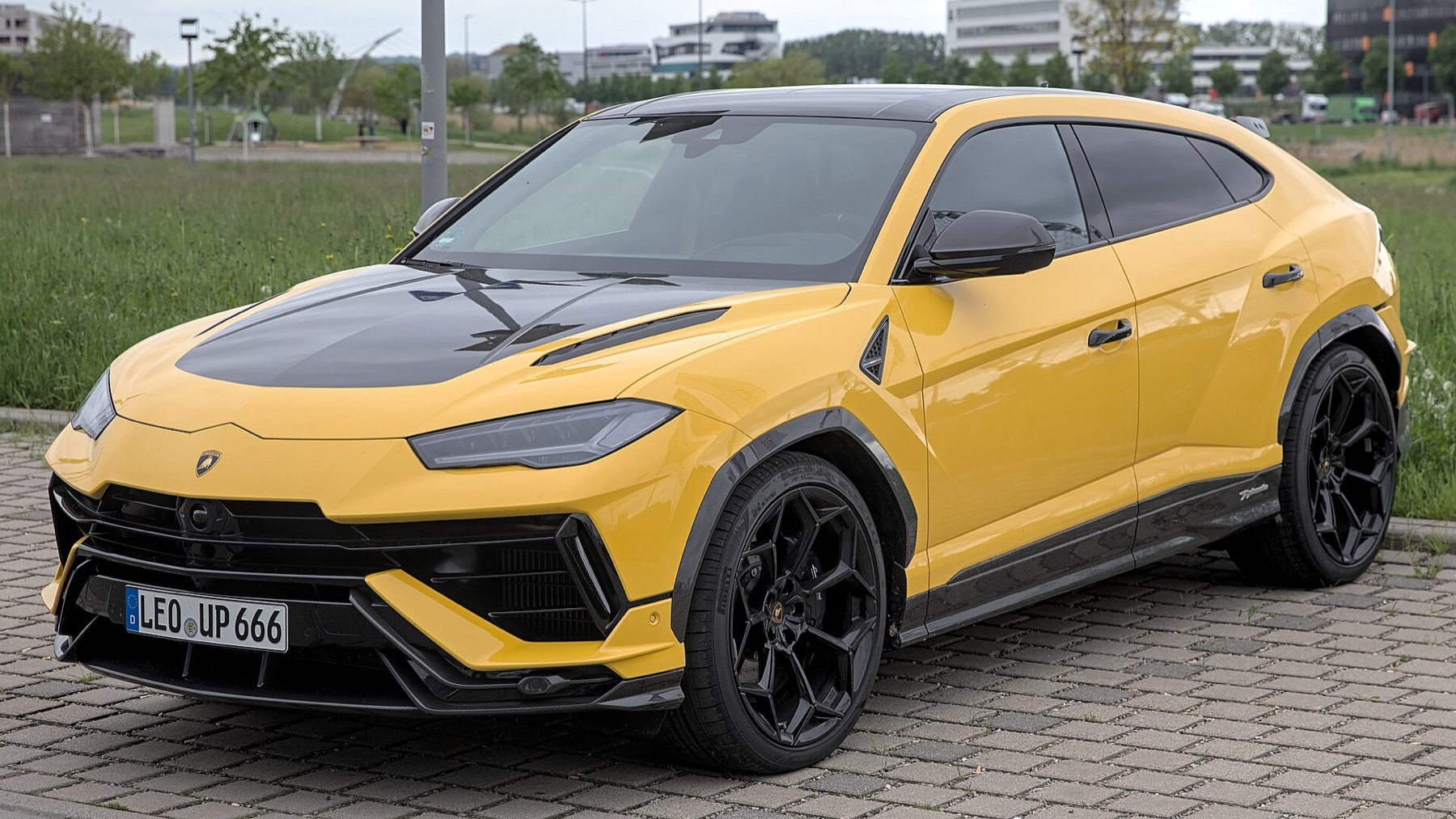
The Urus Performante, also introduced for 2023, is the version that departs from the formula. Lamborghini dropped the air suspension in favor of steel springs, lowered the car, widened the track, and cut weight — a set of decisions aimed squarely at driving behavior rather than comfort.
It shares the 657-horsepower rating with the S, so the premium is not buying power. It is buying the steel-sprung chassis, the Rally drive mode, the carbon-fiber body elements, and — this is the part that holds value — a production position that reads as the enthusiast variant of the range.
The practical trade is real and should be evaluated honestly. Steel springs deliver sharper body control and give up the air suspension's ability to soften a poor road surface or raise the car for a steep driveway, which is a daily-use consideration in a vehicle that is, for most owners, a daily-use vehicle.
The Performante premium is not a power premium. It is a chassis premium, and whether it is worth paying depends entirely on the roads you actually drive.
How the 2025 Urus SE Changes the Math for ICE Cars
Lamborghini introduced the Urus SE plug-in hybrid for the 2025 model year, pairing the twin-turbo V8 with an electric motor for a combined system output the marque published at 789 horsepower, with an electric-only driving range Lamborghini has quoted at roughly 60 kilometers on the WLTP cycle. US EPA figures differ from WLTP and should be checked against the EPA listing rather than assumed.
The SE's arrival does two things to the pure-combustion cars below it. It moves the performance ceiling upward, which compresses the perceived gap between a 641-horsepower launch car and a 657-horsepower S — when the flagship makes 789, the sixteen-horsepower difference between the older trims stops registering as a reason to pay more.
It also introduces a plug-in hybrid drivetrain into a range that had none, which historically softens residuals on the outgoing pure-ICE variants in the near term. Whether that reverses over a longer horizon is genuinely unknown; a case can be made that the last non-hybrid Urus generation eventually reads as the purer proposition to collectors, but that is a thesis, not a forecast, and no buyer should pay a premium today against it.
Service, Intervals, and the Cost of Ownership
The Urus shares its core V8 architecture with other vehicles in the Volkswagen Group performance catalogue, which is relevant to a buyer because it means parts and diagnostic knowledge exist outside the Lamborghini network. That does not make the car inexpensive to run; it makes it less unpredictable than a V12 Lamborghini.
Lamborghini specifies annual servicing for the Urus, with the interval defined by time or mileage, whichever arrives first — confirm the exact schedule for a given model year against the owner's manual or a Lamborghini dealer, as published intervals have varied across the run. Owners should budget for annual service regardless of mileage driven, because the time trigger catches low-use cars.
The consumables are where the Urus separates itself from an ordinary luxury SUV. Carbon-ceramic brakes are standard equipment, tires are staggered and high-performance, and the air suspension on pre-Performante cars is a wear item with a real replacement cost.
The Pre-Purchase Inspection List
No used Urus should change hands without a pre-purchase inspection at a Lamborghini or qualified Volkswagen Group performance specialist. The items worth specific attention are consistent across the model run.
- Air suspension condition. Applies to every Urus except the Performante. Check compressor operation, ride-height consistency across all four corners, and any history of leaks or overnight settling.
- Carbon-ceramic brake wear. Measured by disc weight rather than visual thickness. A set at the wear limit is a substantial expense, and asking for measured figures rather than an opinion is standard practice.
- Service history completeness. Verify every annual service was performed, including on low-mileage cars where owners sometimes skip the time-based interval.
- Software and recall status. Confirm all campaigns have been completed against the VIN through a Lamborghini dealer, which is the only authoritative source.
- Tire age and matching. High-performance tires degrade with age independent of tread depth. Mismatched brands or axles are a negotiating point and, on an all-wheel-drive car, a genuine mechanical concern.
All of the above resolves to a single principle: on a car where four model years drive identically, the inspection report is the pricing document. A 2019 with complete history and healthy consumables is a better purchase than a 2022 with deferred maintenance, and the market does not always price that correctly.
Editorial Recommendation
- Lowest cost of entry: a 2019 or 2020 launch car with documented annual service, measured brake figures, and no air suspension history. This is where the floor is, and the driving experience gives up nothing to a 2022.
- Best overall buy: a 2023 Urus S. It carries the 657-horsepower rating, the refreshed cabin and exterior, and retains air suspension — the combination that suits the way these cars are actually used.
- For the driver who wants the chassis: the 2023 or later Performante, accepting the steel-sprung ride and the premium that comes with it. Do not buy it for the power; it makes the same figure as the S.
- Approach with a clear thesis: the 2025 SE. It is the most capable Urus, but it is also the newest, which means it has the most depreciation ahead of it.
A buyer comparing the Urus against its direct rivals should read our Bentayga, Cullinan, Urus and Purosangue comparison before committing, since the segment's alternatives price differently across the used curve. Those weighing a used Lamborghini more broadly will find the Huracán used market analysis a useful counterpoint, and anyone considering a factory-backed purchase should review how CPO exotic warranty coverage applies to Lamborghini's program. For buyers in a specific metro, our guide to buying a Lamborghini in Los Angeles covers dealer density and inventory depth in the largest US market for the marque.
Keep in mind that every figure in this piece should be verified against current listings before an offer is made. Asking prices on the Urus have moved meaningfully across 2024 and 2025, and a depreciation curve is a description of the past rather than a promise about the next twelve months.